AML compliance is not simply about having policies in place, collecting customer identification documents, or conducting occasional sanctions screening.
An effective AML/CFT framework requires businesses to understand their financial crime risks, apply appropriate Customer Due Diligence (CDD), identify beneficial owners, conduct customer risk assessments, monitor relevant changes, recognise suspicious activity, maintain accurate records, and demonstrate that their compliance controls operate effectively.
The UAE’s regulatory framework has also undergone important developments, including Federal Decree by Law No. (10) of 2025 and Cabinet Resolution No. (134) of 2025, which provide an updated legislative foundation for AML/CFT and combating proliferation financing.
For regulated businesses, preparing for 2027 therefore means reviewing their existing controls against the requirements currently in force, considering relevant regulatory developments, and addressing identified deficiencies.
This AML Compliance Checklist provides a practical guide for organisations seeking to strengthen their compliance readiness before entering 2027.
Why Should Businesses Review Their AML Framework Before 2027?
Financial crime risks continue to evolve as businesses expand into new markets, onboard different customer categories, introduce new products, and engage in increasingly complex transactions.
A compliance framework that was appropriate when a business first commenced operations may no longer adequately reflect its current risk exposure.
For example, a company may have:
- Expanded into new geographic markets
- Increased its customer base
- Started dealing with higher-risk customers
- Introduced new products or services
- Experienced changes in ownership or management
- Increased its reliance on digital customer onboarding
- Identified new sanctions or financial crime risks
- Received observations during regulatory inspections
- Experienced changes in applicable regulatory requirements
A periodic AML/CFT review helps management determine whether the organisation’s policies, procedures, systems, and internal controls remain appropriate.
The objective should not simply be to prepare for a regulatory inspection. It should be to establish a sustainable, risk-based compliance framework capable of identifying, assessing, managing, and documenting relevant financial crime risks.
1. Review Your AML/CFT Policies and Procedures
The first step towards 2027 readiness is reviewing the organisation’s documented AML/CFT policies and procedures.
Policies should reflect the applicable legal and regulatory framework, the organisation’s business activities, customer profile, operational processes, and financial crime risk exposure.
A comprehensive review should consider whether the framework adequately addresses:
- Customer identification and verification
- Customer Due Diligence
- Ultimate Beneficial Ownership
- Customer Risk Assessment
- Enhanced Due Diligence
- Sanctions and PEP screening
- Adverse media screening
- Ongoing monitoring
- Suspicious activity identification and escalation
- Regulatory reporting
- Record keeping
- Employee training
- Compliance governance
- Internal controls and independent reviews
Businesses should also verify that their policies reflect relevant developments under the UAE’s updated AML/CFT legislative framework.
Importantly, policies should not merely reproduce regulatory requirements. They should clearly explain how the organisation implements those requirements in practice.
2. Update Your Enterprise-Wide Risk Assessment
An Enterprise-Wide Risk Assessment (EWRA) is a fundamental component of an effective AML/CFT framework.
It helps businesses identify and assess their exposure to money laundering, terrorist financing, proliferation financing, and other relevant financial crime risks.
Before entering 2027, organisations should consider whether their existing EWRA remains appropriate.
The assessment should reflect relevant risk factors, including:
- Customer categories
- Geographic exposure
- Products and services
- Delivery channels
- Transaction characteristics
- Customer ownership structures
- Higher-risk jurisdictions
- Relevant sanctions exposure
- Emerging financial crime risks
- Changes in the business model
An EWRA should not be treated as a document prepared once and retained without further review.
Where business activities or risk exposures change, the assessment should be updated accordingly.
Management should also consider whether the controls designed to mitigate identified risks remain effective.
3. Review Customer Due Diligence Procedures
Customer Due Diligence remains one of the most important components of AML compliance.
Businesses should assess whether their customer onboarding procedures collect sufficient information to identify and verify customers in accordance with applicable requirements.
Depending on the customer type and relationship, relevant information may include:
- Full legal name
- Nationality
- Date of birth
- Emirates ID or passport information
- Residential or registered address
- Contact information
- Occupation or business activities
- Purpose and intended nature of the relationship
- Ownership and control information
- Relevant supporting documentation
For corporate customers, additional measures may be necessary to understand the legal entity, authorised representatives, shareholders, and ultimate beneficial owners.
The review should also consider whether customer records are complete, current, and supported by appropriate verification evidence.
4. Verify Ultimate Beneficial Ownership Information
Identifying the individuals who ultimately own or control a customer is particularly important when dealing with legal entities.
Complex corporate structures, layered ownership arrangements, and cross-border relationships can make beneficial ownership difficult to establish.
Businesses should review whether their procedures adequately address:
- Identification of beneficial owners
- Verification of relevant ownership information
- Understanding complex ownership structures
- Identification of controlling individuals
- Documentation of beneficial ownership findings
- Updating ownership information when circumstances change
Simply obtaining a trade licence or incorporation document may not always provide sufficient information to establish ultimate ownership and control.
Where ownership structures are complex or unusual, additional review may be necessary.
5. Reassess Customer Risk Classification
Customer Risk Assessment (CRA) helps organisations determine the appropriate level of due diligence and monitoring for individual customers and business relationships.
Before 2027, businesses should review whether their customer risk methodology remains appropriate.
Relevant factors may include:
- Customer type
- Nationality and residence
- Geographic exposure
- Business activities
- Ownership structure
- PEP exposure
- Sanctions-related risk
- Source of funds
- Products and services
- Expected transaction activity
- Other relevant financial crime indicators
The methodology should reflect the organisation’s approved risk-based approach.
Businesses should also consider whether customer risk ratings are being updated when material changes occur.
Using appropriate AML Compliance Software in the UAE can help organisations document customer risk assessments, apply approved risk methodologies more consistently, and maintain relevant assessment records.
6. Strengthen Sanctions and PEP Screening Controls
Sanctions and Politically Exposed Person (PEP) screening should form part of the organisation’s broader customer due diligence and risk management framework.
Businesses should review whether relevant customers and connected parties are screened in accordance with applicable requirements.
Depending on the relationship, screening may involve:
- Individual customers
- Corporate customers
- Ultimate Beneficial Owners
- Directors
- Authorised representatives
- Other relevant connected parties
The review should also consider whether potential screening matches are properly investigated.
An effective screening process should maintain records showing:
- When screening was conducted
- Who or what was screened
- The screening result
- How potential matches were assessed
- Who reviewed the result
- What decision was taken
- Whether further escalation was required
Appropriate AML Compliance Software in Dubai can help centralise screening activity and maintain consistent records of compliance decisions.
However, automated screening should support rather than replace professional assessment.
7. Review Adverse Media Screening Procedures
Adverse media screening can provide additional information about potential financial crime risks associated with customers and beneficial owners.
Relevant information may relate to allegations or reported involvement in fraud, corruption, money laundering, organised crime, sanctions violations, or other financial crimes.
Businesses should assess whether their procedures adequately address the identification and review of relevant adverse media.
Important considerations include:
- Credibility of the information source
- Correct identification of the individual or entity
- Nature and seriousness of the information
- Relevance to the business relationship
- Whether additional due diligence is required
- Whether the customer’s risk classification should change
Adverse media findings should be assessed in context rather than automatically treated as evidence of wrongdoing.
8. Review Enhanced Due Diligence Measures
Higher-risk customers and relationships may require Enhanced Due Diligence.
Businesses should evaluate whether their EDD procedures are appropriately designed and consistently implemented.
Depending on the circumstances, EDD measures may include:
- Obtaining additional customer information
- Understanding the purpose of the relationship in greater detail
- Obtaining additional beneficial ownership information
- Establishing Source of Funds
- Establishing Source of Wealth
- Obtaining supporting documentation
- Conducting additional adverse media checks
- Obtaining appropriate senior management approval
- Applying enhanced monitoring
A key consideration is whether the organisation can demonstrate why a customer was classified as higher risk and what additional measures were performed.
9. Evaluate Source of Funds and Source of Wealth Procedures
Source of Funds (SOF) and Source of Wealth (SOW) are particularly important when assessing higher-risk relationships or transactions.
Although related, the two concepts serve different purposes.
Source of Funds generally refers to the origin of the money used for a particular transaction or business relationship.
Source of Wealth refers more broadly to how an individual accumulated their overall wealth.
Businesses should review whether their procedures clearly explain when SOF or SOW information should be obtained and when supporting documentation is necessary.
The objective is to assess whether the customer’s financial circumstances are reasonably consistent with the nature and value of the proposed relationship or transaction.
10. Assess the Effectiveness of Ongoing Monitoring
AML compliance does not end when a customer is onboarded.
Customer circumstances and risk profiles may change over time.
For example:
- A customer may become a PEP
- A customer may become subject to sanctions
- New adverse media information may emerge
- Beneficial ownership may change
- Business activities may change
- Geographic exposure may increase
- New financial crime risk indicators may arise
Businesses should review whether their ongoing monitoring arrangements are appropriate to the risks associated with their customers and activities.
AML Compliance Software in the UAE can support ongoing screening for changes in sanctions, PEP, and relevant adverse media information.
However, screening-related monitoring is only one component of the broader ongoing monitoring obligations that may apply to regulated businesses.
11. Review Suspicious Transaction Reporting Procedures
One of the most important areas to assess before 2027 is the organisation’s ability to identify, escalate, assess, and report suspicious transactions or activities.
Employees should understand how to recognise potentially suspicious circumstances and when to escalate concerns to the designated compliance personnel or Money Laundering Reporting Officer (MLRO).
Potential warning signs may include:
- Unusual transactions inconsistent with the customer’s profile
- Unexplained third-party payments
- Attempts to conceal beneficial ownership
- Unusual transaction complexity
- Reluctance to provide required customer information
- Transactions lacking an apparent legitimate economic purpose
- Other circumstances giving rise to reasonable suspicion
Where the legal reporting criteria are met, the appropriate Suspicious Transaction Report (STR), Suspicious Activity Report (SAR), or other applicable report should be submitted to the UAE Financial Intelligence Unit through the prescribed reporting mechanism without delay.
Reporting obligations should not be confused with routine screening or customer risk assessment.
Businesses should maintain appropriate procedures covering internal escalation, assessment, confidentiality, regulatory reporting, and record keeping.
12. Review goAML and Other Regulatory Reporting Requirements
Regulated businesses should also verify that their regulatory reporting procedures remain appropriate.
Depending on the sector and circumstances, obligations may include:
- STR and SAR reporting
- Real Estate Activity Reports (REAR)
- Dealers in Precious Metals and Stones Reports (DPMSR)
- Other applicable reports or notifications
These reports serve different regulatory purposes.
For example, a transaction that meets the criteria for a particular sector-specific report may also require separate assessment for suspicious activity.
Businesses should ensure that relevant employees understand the reporting requirements applicable to their activities.
The organisation should also maintain appropriate internal controls to support timely identification, escalation, and completion of applicable reports.
13. Review AML Record-Keeping Practices
Proper documentation is essential for demonstrating the effectiveness of an AML/CFT framework.
Businesses should evaluate whether compliance records are complete, accurate, accessible to authorised personnel, and retained in accordance with applicable requirements.
Relevant records may include:
- Customer identification documents
- CDD and EDD documentation
- Beneficial ownership information
- Customer risk assessments
- Screening results
- Adverse media assessments
- Source of funds and wealth documentation
- Internal compliance approvals
- Suspicious activity escalation records
- Regulatory reporting records
- AML training records
- Internal audit reports
- Corrective action records
A well-maintained audit trail can help organisations demonstrate how compliance decisions were reached.
14. Review AML/CFT Training Programmes
Employees play an important role in identifying and escalating potential financial crime risks.
Businesses should assess whether their AML/CFT training programmes remain appropriate for their activities and employee responsibilities.
Training may cover:
- Customer Due Diligence
- Beneficial ownership
- Customer Risk Assessment
- Sanctions and PEP screening
- Adverse media
- Enhanced Due Diligence
- Source of Funds and Source of Wealth
- Sector-specific red flags
- Suspicious transaction reporting
- Regulatory reporting
- Internal escalation procedures
- Record keeping
- Relevant regulatory developments
Training should be practical and tailored to the organisation’s operations.
Employees should understand not only what the procedures require but also why they are important.
15. Assess Compliance Governance and Management Oversight
An effective AML/CFT framework requires appropriate governance and clearly defined responsibilities.
Businesses should review whether responsibility for AML compliance has been properly assigned and whether relevant personnel have sufficient authority and access to information.
The review may consider:
- Roles and responsibilities of compliance personnel
- Appointment and responsibilities of the MLRO, where applicable
- Senior management oversight
- Internal reporting arrangements
- Escalation of significant compliance matters
- Availability of appropriate resources
- Independence of compliance functions where required
- Monitoring of corrective actions
Senior management should receive sufficient information to understand the organisation’s financial crime risk exposure and significant compliance issues.
16. Conduct an Independent AML/CFT Review or Audit
An important part of assessing 2027 readiness is determining whether the organisation’s AML/CFT framework operates effectively in practice.
An independent AML/CFT review or audit can help identify deficiencies that may not be apparent through routine compliance activities.
Depending on the business and applicable requirements, the review may cover:
- AML/CFT policies and procedures
- Enterprise-Wide Risk Assessment
- Customer Risk Assessment methodology
- Customer onboarding files
- CDD and EDD procedures
- Beneficial ownership verification
- Sanctions and PEP screening
- Ongoing monitoring
- Regulatory reporting
- Employee training
- Record keeping
- Compliance governance
- Previous audit findings
The review should consider both the design of the controls and whether they are operating effectively.
Where deficiencies are identified, the organisation should establish an appropriate corrective action plan.
17. Track and Resolve Compliance Deficiencies
Identifying deficiencies is only the first stage of improving AML compliance.
Businesses should establish procedures to ensure that identified issues are properly addressed.
A corrective action plan should generally include:
- Description of the deficiency
- Assessment of its significance
- Required corrective action
- Responsible personnel
- Target completion date
- Management oversight
- Evidence of remediation
- Follow-up review where appropriate
Unresolved findings should be monitored and escalated in accordance with their significance.
The objective is to ensure that identified weaknesses result in meaningful improvements rather than remaining open indefinitely.
18. Evaluate Whether Your AML Technology Remains Appropriate
As customer volumes and compliance responsibilities increase, organisations may find that manual compliance processes become more difficult to manage.
Spreadsheets, disconnected customer records, and manual screening procedures can create operational challenges.
Appropriate AML Compliance Software in Dubai can help centralise selected AML/CFT activities and support more consistent compliance documentation.
Depending on the platform, relevant functions may include:
- Customer onboarding support
- Sanctions screening
- PEP screening
- Adverse media checks
- Customer Risk Assessment
- Ongoing screening
- Compliance dashboards
- Reporting
- Audit trails
- Record management
Technology can improve efficiency and visibility, but it does not eliminate the need for appropriate compliance procedures, trained employees, professional judgement, and management oversight.
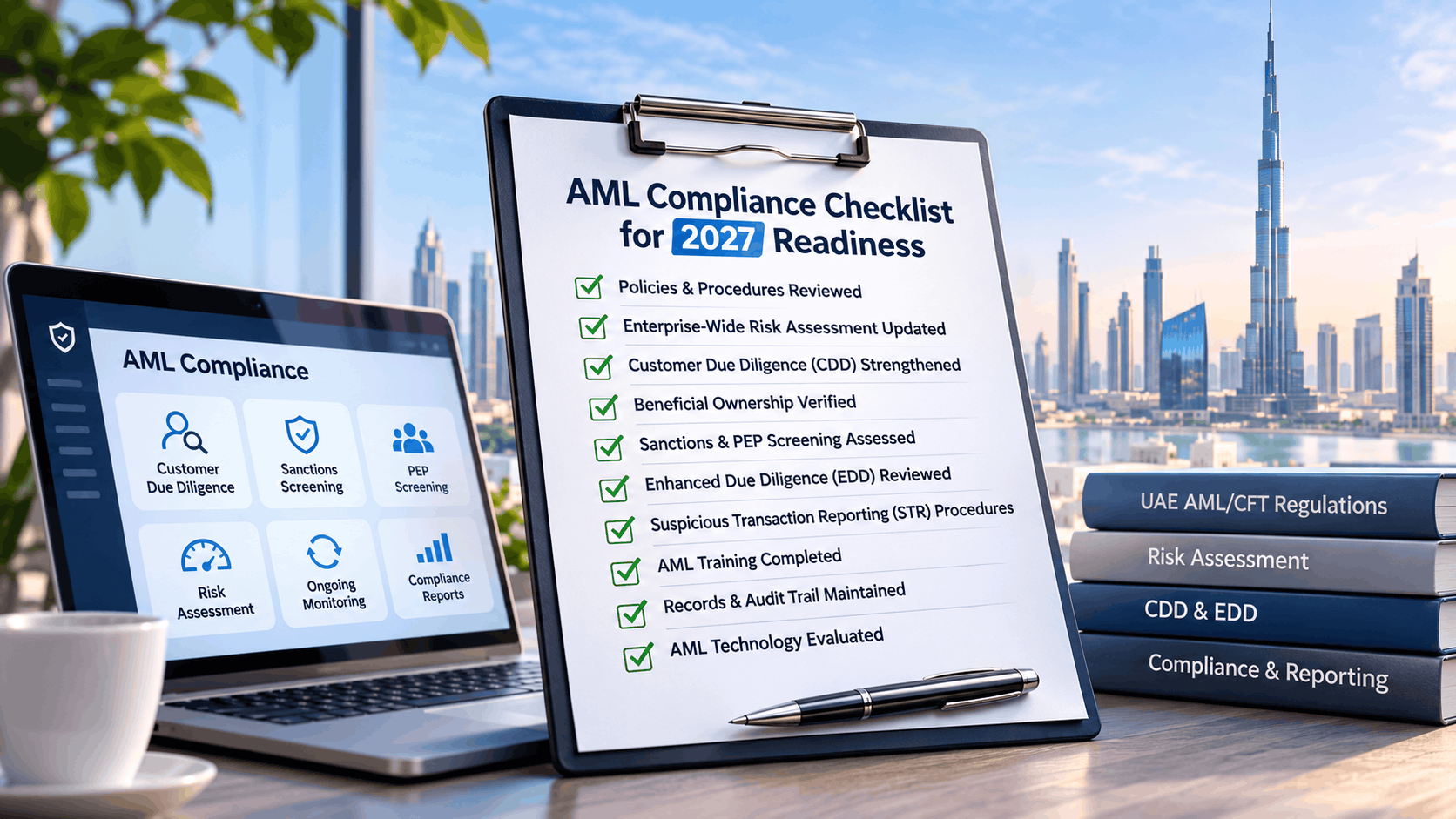
Your 2027 AML Compliance Checklist
Businesses preparing for 2027 can use the following high-level AML Compliance Checklist to assess their existing framework:
- ✓ AML/CFT policies and procedures reviewed against applicable requirements
- ✓ Relevant regulatory developments considered
- ✓ Enterprise-Wide Risk Assessment updated
- ✓ Customer Due Diligence procedures reviewed
- ✓ Ultimate Beneficial Ownership procedures verified
- ✓ Customer Risk Assessment methodology reviewed
- ✓ Sanctions screening procedures assessed
- ✓ PEP screening procedures assessed
- ✓ Adverse media screening procedures reviewed
- ✓ Enhanced Due Diligence controls evaluated
- ✓ Source of Funds and Source of Wealth procedures reviewed
- ✓ Ongoing monitoring arrangements assessed
- ✓ STR/SAR reporting procedures reviewed
- ✓ goAML and sector-specific reporting requirements assessed
- ✓ AML record-keeping procedures reviewed
- ✓ Employee AML/CFT training completed or updated
- ✓ Compliance governance and responsibilities reviewed
- ✓ Independent AML/CFT review or audit considered or completed as applicable
- ✓ Compliance deficiencies documented and remediated
- ✓ AML compliance technology assessed for effectiveness
- ✓ Management oversight and periodic compliance reviews established
This checklist should be adapted to the organisation’s activities, regulatory obligations, risk exposure, and operational complexity.
Completing the checklist does not automatically establish regulatory compliance. Each area should be supported by appropriate policies, procedures, records, and evidence of effective implementation.
How AML Compliance Services Dubai Can Support 2027 Readiness
Preparing for 2027 may require more than reviewing internal documents.
Professional AML Compliance Services Dubai can help businesses assess whether their existing frameworks remain aligned with applicable regulatory requirements and their actual financial crime risk exposure.
Depending on the organisation’s needs, professional support may include:
- AML/CFT framework development and review
- Enterprise-Wide Risk Assessment
- Customer Risk Assessment methodology
- CDD and EDD procedure development
- AML/CFT training
- Independent AML/CFT audits
- Compliance gap assessments
- Regulatory inspection preparedness
- Corrective action and remediation support
- Ongoing AML/CFT consultation
External professional assistance can be particularly useful where businesses lack sufficient internal compliance resources or require an independent assessment of existing controls.
However, responsibility for maintaining regulatory compliance remains with the regulated organisation and its responsible management and compliance personnel.
How WinGuardAML Can Support Your AML Compliance Framework
WinGuardAML is designed to support UAE businesses with selected AML/CFT compliance activities.
The platform provides functionality for sanctions and PEP screening, adverse media checks, customer risk assessment, ongoing monitoring, compliance dashboards, reporting, and audit trails.
For businesses preparing their AML/CFT frameworks for 2027, a centralised compliance platform can help improve visibility over customer risk, maintain screening records, document compliance decisions, and support ongoing customer risk reviews.
Using appropriate AML Compliance Software in the UAE can also reduce reliance on fragmented manual records and support a more consistent approach to selected compliance activities.
WinGuardAML is intended to complement an organisation’s broader AML/CFT framework while leaving investigation, escalation, regulatory reporting decisions, and compliance accountability with the responsible professionals.
Conclusion
As 2027 approaches, regulated businesses in Dubai and across the UAE should consider whether their AML/CFT frameworks remain appropriate, effective, and aligned with applicable regulatory requirements.
An effective compliance framework requires more than documented policies. It requires a clear understanding of financial crime risks, appropriate customer due diligence, beneficial ownership verification, customer risk assessment, screening, monitoring, regulatory reporting, employee training, record keeping, and management oversight.
A structured AML Compliance Checklist can help businesses identify areas requiring attention and establish priorities for improvement.
Combining professional AML Compliance Services Dubai with appropriate AML Compliance Software in Dubai can further support compliance efficiency, consistency, documentation, and risk visibility.
Ultimately, being 2027-ready should not mean simply completing another annual compliance exercise.
It should mean maintaining a risk-based AML/CFT framework that is regularly reviewed, properly documented, effectively implemented, and capable of adapting to changes in business activities, financial crime risks, and regulatory expectations.