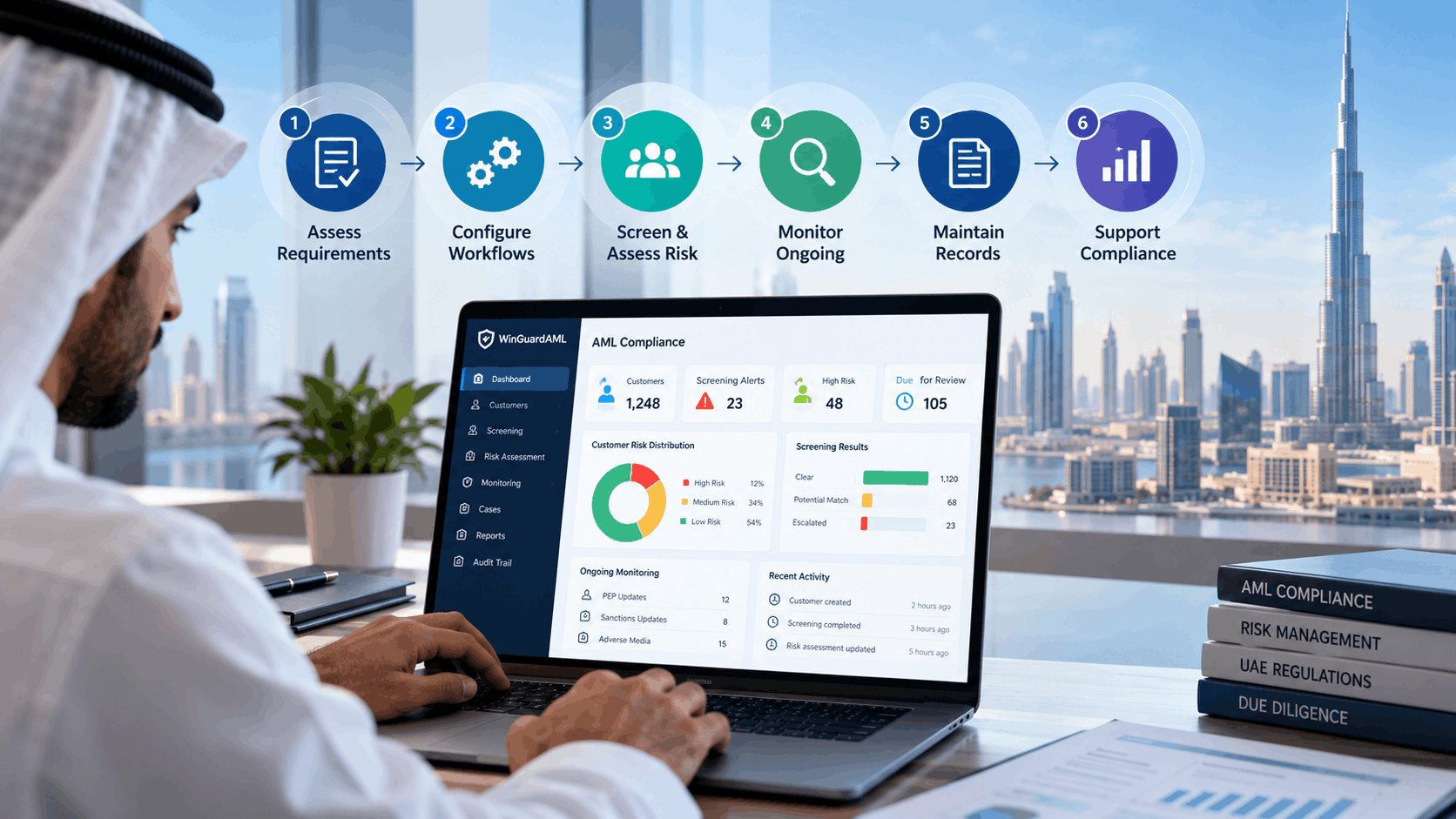
Regulated businesses need to understand their financial crime risks, conduct Customer Due Diligence (CDD), identify beneficial owners, assess customer risk, apply Enhanced Due Diligence (EDD) where necessary, perform appropriate sanctions and PEP screening, maintain records, monitor relevant changes, train employees, and meet applicable regulatory reporting obligations.
As customer volumes and compliance responsibilities increase, managing these activities through spreadsheets, emails, and disconnected records can become increasingly challenging.
This is where AML Compliance Software in UAE can support businesses by centralising selected compliance activities, improving consistency, strengthening documentation, and providing compliance teams with greater visibility over customer risk.
However, implementing AML software should not simply involve purchasing a system and giving employees access.
Successful implementation requires planning, appropriate configuration, accurate data, clearly defined responsibilities, employee training, testing, and ongoing review.
The following step-by-step guide explains how UAE businesses can approach the implementation of AML compliance software within their existing compliance framework.
Step 1: Understand Your Regulatory and AML/CFT Obligations
Before selecting or implementing AML software, a business should first understand the regulatory requirements applicable to its activities.
AML/CFT obligations can vary depending on the type of organisation, regulatory authority, business activities, customer profile, products and services, and financial crime risks.
For example, requirements applicable to a financial institution may differ from those applicable to a Designated Non-Financial Business and Profession (DNFBP).
Depending on the sector, relevant businesses may include:
- Real estate brokers and agents
- Dealers in precious metals and stones
- Auditors and accountants
- Corporate service providers
- Financial institutions
- Exchange houses
- Other regulated businesses
Technology should therefore be configured around the organisation’s actual compliance obligations rather than forcing the organisation to adapt its compliance framework to a generic software configuration.
Step 2: Assess Your Existing AML Compliance Process
Before implementing new technology, review how AML compliance is currently managed.
Map the existing process from customer onboarding through ongoing compliance activities.
Questions to consider include:
- How is customer information currently collected?
- How are customers and beneficial owners identified?
- How is Customer Due Diligence performed?
- How are sanctions and PEP checks conducted?
- How are customer risk assessments completed?
- How are higher-risk customers identified?
- How is Enhanced Due Diligence documented?
- How are screening results reviewed?
- How are customer records updated?
- How is ongoing monitoring performed?
- How are compliance decisions documented?
- How are potential suspicious activities escalated?
- Where are compliance records stored?
- How does management receive compliance information?
This exercise can identify processes that are working effectively as well as areas involving excessive manual work, duplicated effort, fragmented records, or inconsistent documentation.
The objective should not be to automate everything. It should be to identify where technology can provide meaningful compliance and operational benefits.
Step 3: Define What You Need the AML Software to Do
Not every organisation needs the same AML compliance technology.
Before evaluating systems, develop a clear list of functional requirements based on the organisation’s risk profile and compliance responsibilities.
Depending on the business, requirements may include:
- Customer onboarding support
- Sanctions screening
- PEP screening
- Adverse media screening
- Customer Risk Assessment (CRA)
- Ongoing monitoring
- Customer review reminders
- Compliance workflows
- Audit trails
- Management dashboards
- User access controls
- Compliance reporting
- Record management
Separating essential requirements from optional features can make software evaluation more effective.
A business should avoid selecting a system simply because it offers the largest number of features. The priority should be whether those features address the organisation’s actual compliance requirements.
Step 4: Select Appropriate AML Compliance Software
Once requirements have been defined, businesses can evaluate available AML Compliance Software in Dubai and across the UAE.
Important factors to consider include:
- Coverage of relevant sanctions and PEP data
- Adverse media capabilities
- Customer risk assessment functionality
- Ongoing monitoring capability
- Ease of use
- Ability to maintain audit trails
- Reporting functionality
- User roles and access controls
- Data security
- Scalability
- Technical support
- Implementation assistance
- Ability to adapt to the organisation’s compliance processes
The software should also be practical for the employees who will actually use it.
A technically sophisticated platform may provide limited value if compliance teams find it difficult to operate or if it does not fit naturally into existing workflows.
Step 5: Define the Customer Onboarding Workflow
Customer onboarding is one of the most important areas to configure correctly.
The organisation should determine what information needs to be collected for different customer categories.
For individuals, this may include:
- Full name
- Nationality
- Date of birth
- Identification information
- Address
- Occupation or employment
- Contact details
- Purpose and nature of the relationship
For legal entities, additional information may include:
- Legal name
- Trade licence or registration details
- Registered address
- Business activities
- Shareholding information
- Directors or authorised representatives
- Ultimate Beneficial Owners (UBOs)
The software workflow should support the organisation’s approved CDD procedures rather than replacing them.
Step 6: Configure Customer Risk Assessment
A risk-based approach is central to AML/CFT compliance.
The AML platform should therefore support the organisation’s approved Customer Risk Assessment methodology.
Depending on the business, risk factors may include:
- Customer type
- Nationality or residence
- Geographic exposure
- Business activity
- Ownership structure
- Products or services
- Delivery channels
- PEP exposure
- Sanctions exposure
- Transaction or relationship characteristics
- Source of funds
- Other relevant financial crime indicators
Risk weightings and classifications should reflect the organisation’s documented methodology.
Technology can automate calculations and improve consistency, but the underlying risk methodology should be established and approved by the organisation.
Compliance personnel should also be able to understand why a particular customer received a particular risk classification.
Step 7: Configure Sanctions and PEP Screening
Screening is often one of the primary reasons organisations implement AML compliance software.
The business should determine:
- Who needs to be screened
- When screening should occur
- Which relevant databases should be checked
- How potential matches will be reviewed
- Who is responsible for clearing false positives
- When escalation is required
- How decisions will be documented
Relevant parties may include customers, beneficial owners, directors, authorised representatives, or other connected persons depending on the nature of the relationship and applicable requirements.
Screening should not become a simple “match/no-match” exercise.
Potential matches require appropriate review and documentation.
Step 8: Configure Adverse Media Screening
Adverse media can provide additional information about potential financial crime or reputational risks.
AML compliance software may help identify relevant negative information relating to customers or connected parties.
However, adverse media should be assessed carefully.
The organisation should consider factors such as:
- Reliability of the source
- Relevance of the information
- Whether the individual or entity has been correctly identified
- Nature of the alleged conduct
- Date and current relevance of the information
- Relationship to the customer’s overall risk profile
An adverse media result should generally be treated as information requiring assessment rather than automatic evidence of wrongdoing.
Step 9: Establish Enhanced Due Diligence Workflows
Higher-risk relationships may require Enhanced Due Diligence.
The AML platform should help compliance teams identify higher-risk customers and document the additional measures taken.
Depending on the circumstances, EDD may involve:
- Obtaining additional customer information
- Obtaining additional beneficial ownership information
- Establishing Source of Funds
- Establishing Source of Wealth
- Conducting additional adverse media checks
- Understanding the purpose of the relationship in greater detail
- Obtaining additional supporting documents
- Obtaining appropriate senior management approval
- Applying enhanced monitoring
A structured EDD workflow can help ensure that higher-risk cases receive appropriate attention and that the reasons for compliance decisions are documented.
Step 10: Set Up Ongoing Monitoring
Customer risk can change after onboarding.
A customer may become a PEP, become subject to sanctions, experience a change in beneficial ownership, appear in relevant adverse media, or otherwise present new risk indicators.
Ongoing monitoring helps organisations identify these changes.
When configuring AML Compliance Software in UAE, businesses should determine:
- Which customers or related parties require ongoing screening
- How frequently information should be reviewed
- What changes should generate alerts
- Who will review those alerts
- How decisions will be documented
- When customer risk should be reassessed
Ongoing monitoring should therefore connect with the organisation’s customer review and risk assessment processes.
Step 11: Define Alert Review and Escalation Procedures
Technology can identify potential risks, but employees need clear instructions about what happens next.
The organisation should establish procedures explaining:
- Who receives alerts
- Who investigates potential matches
- What information should be reviewed
- When additional documentation should be requested
- When matters should be escalated
- Who can close an alert
- How the decision should be documented
Where circumstances create potential suspicion, the matter should be escalated through the organisation’s established internal AML/CFT procedures to the appropriate compliance personnel or MLRO.
The AML software should support this process without replacing the professional judgement required to assess suspicious circumstances.
Step 12: Migrate and Validate Existing Customer Data
Businesses implementing a new AML platform may need to transfer existing customer information into the system.
Data migration should be carefully managed.
Before migration, organisations should consider whether existing information is:
- Complete
- Accurate
- Current
- Consistently formatted
- Supported by appropriate documentation
Migrating poor-quality information into a new system will not solve underlying data-quality problems.
After migration, appropriate validation or sample testing should be performed to confirm that customer records have been transferred correctly.
Step 13: Configure User Roles and Access Controls
Not every employee should necessarily have the same level of access to AML information.
The organisation should define roles based on employees’ responsibilities.
For example, access may differ between:
- Front-office employees
- Operations teams
- Compliance personnel
- MLRO
- Senior management
- System administrators
- Internal auditors
Appropriate access controls can help protect sensitive customer and compliance information while maintaining accountability.
The system should also maintain audit trails showing relevant user activity.
Step 14: Test the AML Software Before Full Implementation
Before going live, the organisation should test whether the system operates as expected.
Testing may include:
- Customer onboarding
- Individual screening
- Corporate screening
- UBO screening
- PEP identification
- Potential sanctions matches
- Customer risk scoring
- Higher-risk customer workflows
- Adverse media results
- Ongoing monitoring alerts
- User permissions
- Audit trails
- Reports and dashboards
Testing should involve compliance personnel as well as relevant operational users.
Any configuration issues should ideally be addressed before the platform becomes part of the organisation’s live compliance process.
Step 15: Train Employees
Technology is effective only when employees understand how to use it.
Training should therefore cover both system operation and the compliance reasoning behind the workflow.
Relevant employees should understand:
- What information must be entered
- How screening should be performed
- How potential matches should be reviewed
- How customer risk assessments work
- How EDD should be documented
- How alerts should be handled
- When matters should be escalated
- How compliance decisions should be recorded
- Who to contact when additional guidance is required
Employees should not simply learn which buttons to click.
They should understand why the compliance process exists.
Step 16: Maintain Proper Audit Trails
One of the important benefits of AML technology is the ability to maintain structured records of compliance activity.
A good audit trail may show:
- Who performed a screening
- When screening was performed
- What result was generated
- Who reviewed a potential match
- Why an alert was closed or escalated
- When a customer risk assessment was completed
- Changes made to customer information
- Approvals provided
- Relevant user activity
These records can support internal compliance reviews, independent AML audits, management oversight, and regulatory examinations.
Step 17: Establish Regulatory Reporting Procedures Separately
Implementing AML compliance software does not remove the organisation’s responsibility to maintain appropriate regulatory reporting procedures.
Depending on the sector and circumstances, businesses may have obligations relating to suspicious transaction or activity reporting and other applicable regulatory reports.
Potentially suspicious matters identified through screening, customer review, or other compliance activities should be escalated internally to the appropriate compliance personnel or MLRO for assessment.
Where applicable reporting thresholds are met, the appropriate report should be submitted through the prescribed regulatory channel.
Businesses should therefore clearly understand the difference between:
- Detecting a potential risk through AML software
- Internally investigating and assessing the matter
- Deciding whether regulatory reporting is required
- Completing the applicable regulatory reporting process
Technology can support the information and documentation needed for these processes, but accountability remains with the regulated organisation and responsible compliance personnel.
Step 18: Monitor Performance After Implementation
Going live should not be considered the end of the implementation process.
Businesses should periodically review whether the AML software is delivering the intended results.
Questions may include:
- Are employees using the system correctly?
- Are customer records complete?
- Are risk assessments being performed consistently?
- Are screening alerts manageable?
- Are potential matches properly documented?
- Are higher-risk customers receiving appropriate review?
- Is ongoing monitoring functioning as intended?
- Are audit trails complete?
- Are management reports useful?
- Are there unnecessary manual processes that can be improved?
Feedback from compliance teams and operational users can help identify opportunities to improve the configuration.
Step 19: Review and Update the System as Risks Change
AML compliance is not static.
The organisation’s customer base, business activities, geographic exposure, products, regulatory requirements, and financial crime risks can change over time.
The software configuration should therefore be reviewed periodically.
Changes may be required to:
- Customer risk factors
- Risk weightings
- Screening procedures
- User access
- Customer information requirements
- EDD workflows
- Monitoring processes
- Reporting
- Internal approval procedures
Technology should evolve alongside the organisation’s AML/CFT framework.
Common Mistakes When Implementing AML Compliance Software
Businesses should also be aware of several common implementation mistakes.
These include:
- Selecting software before understanding compliance requirements
- Assuming technology automatically creates regulatory compliance
- Using generic risk scoring without considering the organisation’s actual risks
- Migrating incomplete or outdated customer data
- Failing to define alert-review responsibilities
- Providing insufficient employee training
- Failing to document compliance decisions
- Giving inappropriate system access
- Not testing the platform before launch
- Treating implementation as a one-time project
- Relying entirely on automated results without professional review
Avoiding these mistakes can significantly improve the effectiveness of an AML technology implementation.
AML Compliance Software Implementation Checklist
Before considering implementation complete, businesses can use the following high-level checklist:
- ✓ Regulatory requirements identified
- ✓ Existing AML processes mapped
- ✓ Software requirements documented
- ✓ Appropriate AML platform selected
- ✓ Customer onboarding workflow configured
- ✓ Customer risk methodology configured
- ✓ Sanctions and PEP screening configured
- ✓ Adverse media process established
- ✓ EDD workflows configured
- ✓ Ongoing monitoring established
- ✓ Alert review and escalation procedures documented
- ✓ Existing customer data validated and migrated
- ✓ User roles and access controls configured
- ✓ System testing completed
- ✓ Employees trained
- ✓ Audit trails tested
- ✓ Regulatory reporting procedures established
- ✓ Post-implementation review scheduled
- ✓ Periodic system and risk review established
The checklist should be adapted to the organisation’s regulatory requirements, size, business model, customer profile, and financial crime risk exposure.
Combining AML Compliance Services UAE with Technology
Implementing technology is only one part of building an effective AML/CFT framework.
Professional AML Compliance Services UAE can help organisations assess regulatory requirements, develop policies and procedures, conduct Enterprise-Wide Risk Assessments, establish customer risk methodologies, design CDD and EDD procedures, provide AML training, perform independent reviews, and address identified compliance deficiencies.
This professional input can also help businesses determine how AML technology should be configured around their compliance framework.
The strongest approach is therefore often a combination of professional expertise, appropriate technology, trained employees, and effective management oversight.
How WinGuardAML Can Support AML Compliance Implementation
WinGuardAML is designed to help UAE businesses centralise and streamline selected AML/CFT compliance activities.
The platform supports functions including sanctions and PEP screening, adverse media checks, customer risk assessment, ongoing monitoring, compliance dashboards, reporting, and audit trails.
For businesses moving away from fragmented or heavily manual compliance processes, a centralised platform can help improve consistency, documentation, visibility, and access to compliance information.
Importantly, technology should complement the organisation’s AML/CFT framework rather than replace the responsibilities of compliance professionals.
Conclusion
Implementing AML Compliance Software in UAE should be approached as a compliance improvement project rather than simply a technology installation.
Successful implementation starts with understanding regulatory obligations and existing processes. It then involves selecting appropriate technology, configuring customer risk and screening workflows, establishing monitoring and escalation procedures, migrating accurate data, training employees, testing the system, and continuously reviewing its effectiveness.
For organisations considering AML Compliance Software in Dubai, the most important question should therefore not be, “How quickly can we install the software?”
The better question is, “How can we implement technology within our AML/CFT framework in a way that improves compliance effectiveness?”
When appropriate technology is combined with professional AML Compliance Services UAE, strong governance, accurate customer information, trained employees, and professional judgement, businesses can build a more structured, efficient, and sustainable approach to AML compliance.