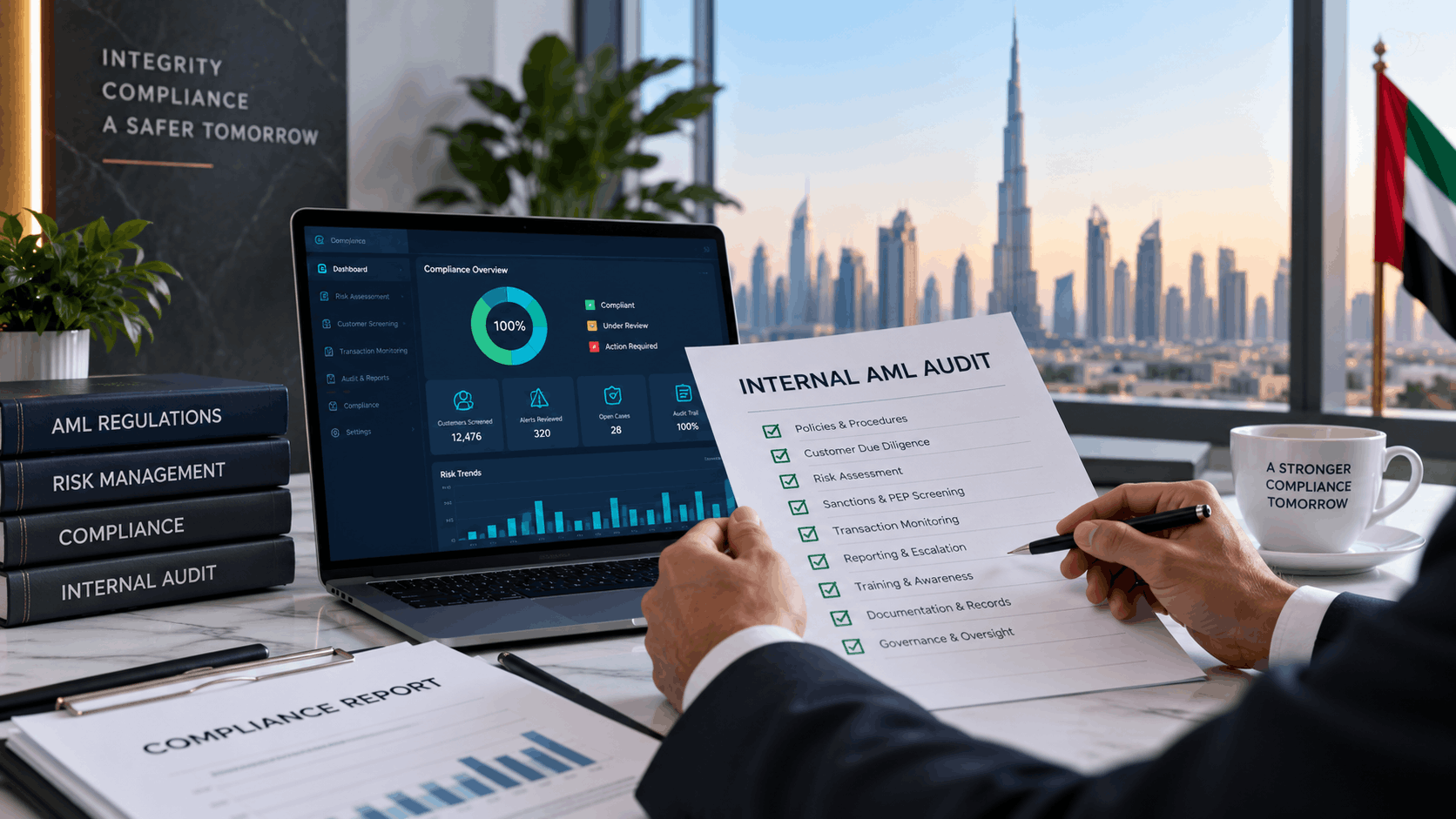
An internal AML audit provides businesses with an opportunity to identify weaknesses in their AML/CFT framework before those weaknesses develop into significant compliance issues. By reviewing policies, customer due diligence, risk assessments, screening, monitoring, documentation, reporting, and governance, businesses can take corrective action and strengthen their overall compliance framework.
While an AML audit cannot guarantee that a business will never face regulatory action, regular and effective AML Audits can significantly support an organisation’s ability to identify gaps, demonstrate compliance efforts, and reduce regulatory risk.
What Is an Internal AML Audit?
An internal AML audit is a structured review of an organisation’s Anti-Money Laundering and Counter-Terrorist Financing framework.
The objective is to assess whether the organisation’s AML/CFT policies, procedures, systems, and controls are appropriately designed and operating effectively.
Unlike routine compliance activities, an AML audit takes a broader and more independent look at how the overall compliance framework is functioning.
Depending on the nature and risk profile of the business, the review may cover areas such as:
- AML/CFT policies and procedures
- Enterprise-Wide Risk Assessment (EWRA)
- Customer Risk Assessment (CRA)
- Customer Due Diligence (CDD)
- Enhanced Due Diligence (EDD)
- Ultimate Beneficial Ownership (UBO) information
- Sanctions and PEP screening
- Ongoing monitoring
- Suspicious activity identification and escalation
- Record keeping and documentation
- AML/CFT training
- Compliance governance and MLRO oversight
- Previous compliance findings and corrective actions
The purpose is not simply to identify mistakes. It is to determine whether the AML/CFT framework remains appropriate for the organisation’s actual financial crime risks.
Why Internal AML Audits Matter in the UAE
AML compliance should not be treated as a one-time exercise.
Businesses change. Customers change. Products and services change. Employees change. Geographic exposure can expand, and new financial crime risks can emerge.
Regulatory requirements and supervisory expectations may also evolve.
A compliance framework that was appropriate when it was originally implemented may therefore require updates over time.
Regular Internal AML Audits can help businesses identify these changes and assess whether existing controls continue to operate as intended.
This creates an opportunity to address weaknesses proactively rather than discovering them only during a regulatory inspection or after a compliance incident.
1. Identifying Gaps Before a Regulatory Inspection
One of the primary benefits of an internal AML audit is early identification of compliance weaknesses.
For example, an audit may identify that:
- Customer files contain outdated KYC information
- Risk assessments have not been periodically reviewed
- Higher-risk customers lack sufficient EDD documentation
- Screening results have not been adequately documented
- Policies no longer reflect current business activities
- Employee AML training records are incomplete
- Compliance alerts are not being appropriately escalated
- Required supporting documents are missing
Individually, some of these issues may appear relatively minor. However, repeated or systemic weaknesses can create greater regulatory exposure.
Identifying such issues internally gives management an opportunity to implement corrective measures before they become more significant.
2. Testing Whether AML Policies Work in Practice
Having an AML policy is important, but the existence of a policy alone does not demonstrate that the underlying controls are effective.
An organisation may have a well-written procedure requiring enhanced due diligence for high-risk customers, for example. An AML audit can test whether employees are actually following that procedure.
The auditor may review a sample of higher-risk customer files to determine whether the required approvals, source-of-funds information, source-of-wealth information, or other enhanced measures were obtained where applicable.
This distinction between what is written and what actually happens operationally is one of the most valuable aspects of an internal AML audit.
3. Strengthening Customer Due Diligence
Customer Due Diligence is a fundamental part of AML/CFT compliance.
An internal AML audit can assess whether customer identification and verification procedures are being applied consistently and whether sufficient information is being collected to understand the nature and purpose of customer relationships.
The review may also consider whether beneficial ownership information is appropriately obtained, customer information is periodically updated, and higher-risk relationships receive enhanced scrutiny.
Where deficiencies are identified, businesses can implement corrective measures such as updating customer files, revising onboarding procedures, or strengthening periodic review processes.
4. Reviewing Customer Risk Assessments
A risk-based approach requires businesses to understand that not every customer presents the same level of financial crime risk.
Customer risk assessments should therefore consider relevant factors such as customer type, business activity, geographical exposure, ownership structure, products or services used, delivery channels, and other applicable risk indicators.
An internal AML audit can evaluate whether the organisation’s risk methodology is being applied consistently and whether customer risk ratings accurately reflect the information available.
The audit may also identify situations where customer circumstances have changed but the risk classification has not been updated.
5. Testing Sanctions and PEP Screening Controls
Sanctions and Politically Exposed Person (PEP) screening are important elements of an effective AML/CFT framework.
An internal AML audit can assess whether customers and relevant related parties are being screened appropriately and whether potential matches are reviewed, escalated, and documented.
The review may examine whether screening takes place at appropriate stages of the customer relationship and whether ongoing screening processes are functioning effectively.
This is particularly important because screening is not simply about having access to a database. Businesses should also maintain appropriate procedures for reviewing and documenting screening results.
6. Reviewing Suspicious Activity Escalation
Employees may occasionally encounter customer behaviour, transactions, or circumstances that require additional compliance review.
Businesses should therefore have clear procedures for identifying and escalating potentially suspicious activity to the appropriate compliance personnel or MLRO.
An internal AML audit can review whether employees understand these procedures and whether internal escalations are appropriately documented and assessed.
The audit can also identify situations where warning signs may have been overlooked or where escalation procedures require improvement.
7. Assessing the Enterprise-Wide Risk Assessment
An Enterprise-Wide Risk Assessment is intended to provide management with an overall understanding of the organisation’s exposure to money laundering, terrorist financing, proliferation financing, sanctions, and other relevant financial crime risks.
An internal AML audit can assess whether the EWRA reflects the organisation’s current business activities and risk exposure.
For example, the review may consider whether the assessment appropriately covers:
- Customer risks
- Geographic risks
- Product and service risks
- Delivery-channel risks
- Transaction-related risks
- Emerging financial crime risks
- Effectiveness of mitigating controls
Where the organisation’s business model has changed, the EWRA may also require updating.
8. Improving AML Training Effectiveness
Employees are an important part of an organisation’s AML/CFT control environment.
Even sophisticated AML Compliance Software UAE solutions cannot compensate for employees who do not understand their compliance responsibilities.
An internal AML audit can review whether relevant employees have received appropriate AML/CFT training and whether training records are maintained.
It can also assess whether training is relevant to employees’ actual responsibilities.
For example, front-office employees may require practical training on customer identification and red flags, while compliance personnel may require more detailed knowledge of screening, risk assessment, escalation, and regulatory reporting requirements.
9. Strengthening Documentation and Audit Trails
In AML compliance, performing a control is only part of the process. Businesses should also be able to demonstrate that the control was performed.
An internal AML audit can identify documentation gaps across areas such as:
- Customer onboarding
- Risk assessments
- Screening results
- EDD reviews
- Compliance approvals
- Internal escalations
- Periodic customer reviews
- Training records
- Management reporting
Strong documentation allows the organisation to demonstrate how compliance decisions were made and what actions were taken.
This can be particularly important when responding to questions from auditors, senior management, or regulatory authorities.
10. Creating a Corrective Action Plan
The value of an AML audit does not end when the audit report is issued.
Where weaknesses are identified, management should develop an appropriate corrective action plan.
The plan can identify the finding, required corrective action, responsible person or department, expected completion date, and current implementation status.
Higher-risk findings may require more immediate attention, while lower-risk improvements may be addressed over a reasonable implementation period.
Follow-up is equally important.
A finding should not be considered resolved merely because management has agreed to take action. Organisations should verify that the corrective measure has actually been implemented.
Can Internal AML Audits Help Reduce the Risk of Regulatory Fines?
Internal AML audits should not be viewed as a guarantee against regulatory penalties.
Regulatory action depends on the specific circumstances, applicable legal and regulatory requirements, the nature and seriousness of any deficiencies, and the relevant authority’s assessment.
However, effective AML Audits can help organisations identify and address compliance weaknesses before they become more serious.
They can also help management demonstrate that the organisation has established processes for reviewing its AML/CFT framework, identifying deficiencies, implementing corrective actions, and continuously improving its controls.
The objective should therefore be broader than simply avoiding fines.
A strong internal AML audit programme helps create a more effective and sustainable compliance environment.
The Role of AML Audit Software and Compliance Technology
Technology can make the AML audit process more efficient by providing auditors and compliance teams with structured and accessible information.
AML Audit Software and broader AML compliance platforms can support areas such as customer risk assessments, screening histories, compliance records, user activity, ongoing monitoring, reporting, and audit trails.
Centralised information can make it easier to select samples, review historical activities, identify exceptions, and verify whether compliance procedures have been followed.
However, technology does not replace the need for professional assessment.
An AML audit requires an understanding of the organisation’s business model, regulatory obligations, customer risks, internal controls, and actual operating practices.
Technology should therefore support the audit process rather than replace professional judgement.
Combining AML Compliance Services with Technology
Businesses may also benefit from combining professional AML Compliance Service in UAE support with appropriate compliance technology.
Professional AML consultants can assist organisations with activities such as AML/CFT framework reviews, Enterprise-Wide Risk Assessments, policies and procedures, independent AML audits, compliance training, and remediation of identified deficiencies.
Technology can complement these services by providing structured customer information, screening records, risk assessments, monitoring information, and audit trails.
Together, professional expertise and technology can provide management with greater visibility over the effectiveness of the organisation’s AML/CFT framework.
How WinGuardAML Can Support AML Compliance and Audit Readiness
WinGuardAML helps organisations centralise and manage selected AML/CFT compliance activities.
The platform supports customer screening against sanctions and PEP data, adverse media checks, customer risk assessment, ongoing monitoring, compliance dashboards, reporting, and audit trails.
Maintaining compliance information in a structured and accessible format can also support audit readiness by making relevant records easier to retrieve during internal reviews, independent AML/CFT audits, or regulatory examinations.
WinGuardAML should therefore be viewed as a technology platform supporting ongoing AML compliance and audit readiness, while the actual audit and compliance assessment remain subject to appropriate professional judgement.
Moving from Reactive to Proactive AML Compliance
One of the biggest benefits of internal AML audits is the opportunity to move from reactive compliance to proactive compliance.
A reactive organisation discovers problems after an inspection, customer incident, or regulatory query.
A proactive organisation regularly tests its own controls, identifies weaknesses, implements corrective measures, and monitors whether those improvements are effective.
This approach can help businesses maintain a stronger AML/CFT framework while reducing the likelihood that unresolved compliance deficiencies accumulate over time.
Conclusion
Internal AML audits are an important part of an effective AML/CFT compliance framework.
They help UAE businesses assess whether their policies, procedures, customer due diligence, risk assessments, screening controls, training, documentation, and governance arrangements are operating as intended.
More importantly, Internal AML Audits give organisations an opportunity to identify weaknesses and take corrective action before those weaknesses become more significant compliance concerns.
When combined with appropriate AML Compliance Software UAE, professional expertise, strong management oversight, and continuous monitoring, regular AML audits can contribute to a more effective and sustainable compliance framework.
The objective is not simply to avoid regulatory fines. It is to build an AML/CFT environment in which risks are identified early, compliance decisions are properly documented, weaknesses are addressed, and management has greater confidence in the effectiveness of its controls.
WinGuardAML supports UAE businesses with technology-enabled AML compliance solutions designed to simplify customer screening, risk assessment, ongoing monitoring, compliance documentation, reporting, and audit readiness.