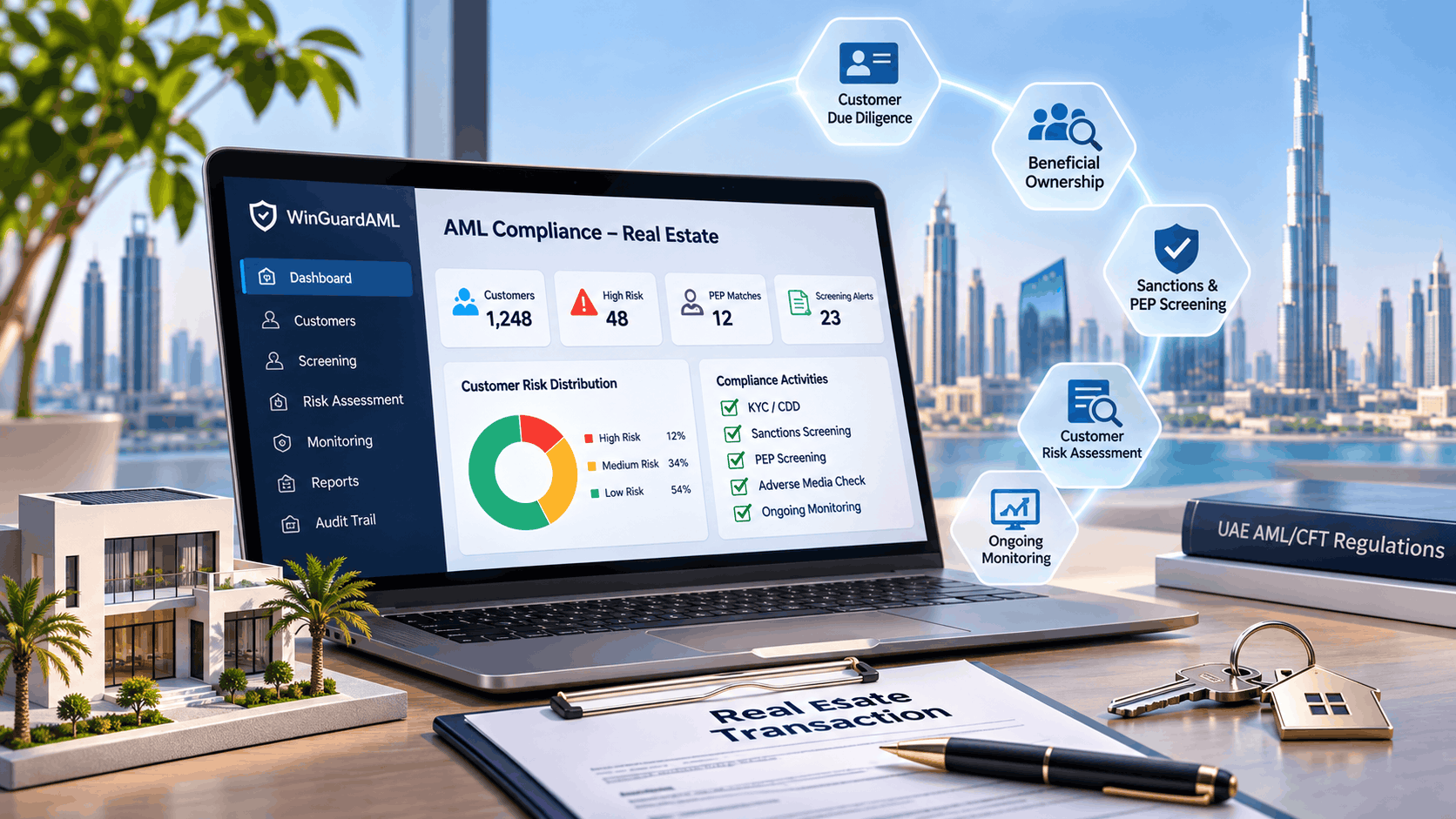
High-value property transactions, cross-border payments, complex ownership structures, and customers from different jurisdictions can create challenges for real estate brokers and agents when performing Anti-Money Laundering and Counter-Terrorist Financing (AML/CFT) compliance activities.
As regulatory expectations evolve, real estate firms increasingly need effective processes for customer identification, beneficial ownership verification, sanctions and Politically Exposed Person (PEP) screening, customer risk assessment, and ongoing monitoring.
Artificial Intelligence (AI) and modern compliance technology can help businesses manage certain aspects of these responsibilities more efficiently.
However, selecting the best AI AML compliance solution for real estate in Dubai requires more than choosing software with advanced technology or automated screening capabilities.
Businesses must evaluate whether the solution addresses their actual regulatory obligations, customer risks, operational requirements, and compliance processes.
This guide explains the role of AI in real estate AML compliance, the capabilities businesses should look for, and how appropriate AML Compliance Solutions in Dubai can support a more effective compliance framework.
1. Why AML Compliance Is Important for Dubai Real Estate Firms
Real estate is a sector that can be vulnerable to money laundering because property transactions may involve significant amounts of money, multiple parties, international investors, and complex financial arrangements.
Real estate brokers and agents carrying out activities within the scope of the UAE’s AML/CFT framework are generally classified as Designated Non-Financial Businesses and Professions (DNFBPs).
Accordingly, they must comply with applicable AML/CFT requirements, including relevant obligations concerning:
- Customer Due Diligence (CDD)
- Ultimate Beneficial Ownership (UBO)
- Customer Risk Assessment (CRA)
- Sanctions and PEP screening
- Enhanced Due Diligence (EDD)
- Ongoing monitoring
- Suspicious transaction reporting
- Record keeping
- Employee AML/CFT training
- Regulatory reporting through applicable channels
The precise requirements depend on the business activities and applicable regulatory framework.
For real estate firms, compliance should therefore be integrated into customer onboarding and transaction-related processes rather than treated as a separate administrative exercise.
2. What Are AI AML Compliance Solutions?
AI AML compliance solutions refer to technologies that use artificial intelligence, machine learning, or related analytical techniques to support selected financial crime compliance activities.
Depending on the system, AI may help analyse information, identify patterns, prioritise alerts, or support the review of large volumes of data.
Potential applications include:
- Screening name-matching improvements
- Identifying potentially relevant adverse media
- Supporting customer risk analysis
- Prioritising compliance alerts
- Detecting unusual patterns where transaction data is available
- Reviewing or extracting information from documents
- Supporting compliance investigations
However, not every AML software platform uses AI in the same way.
Some platforms rely primarily on rules-based screening, structured databases, automated workflows, and predefined risk assessment methodologies.
Others incorporate AI or machine learning into specific functions.
Businesses should therefore distinguish between AI-enabled capabilities and conventional compliance automation when evaluating a software provider.
The most appropriate solution is not necessarily the one with the most AI features, but the one that supports the organisation’s compliance obligations effectively.
3. Key AML Challenges Faced by Real Estate Companies in Dubai
Before selecting AML technology, real estate firms should understand the practical compliance challenges associated with their business activities.
Customer Identification and Verification
Real estate firms may deal with individual buyers, sellers, corporate customers, investors, and authorised representatives.
Obtaining accurate identification information and maintaining complete customer records can become challenging as transaction volumes increase.
Complex Beneficial Ownership Structures
Property transactions involving corporate entities may require additional procedures to identify the individuals who ultimately own or control the relevant companies.
Layered ownership structures and international corporate arrangements may increase the complexity of beneficial ownership verification.
Sanctions and PEP Screening
Customers and relevant connected parties may need to be screened against applicable sanctions lists and PEP information.
Potential matches require appropriate investigation to distinguish genuine risks from false positives.
Customer Risk Assessment
Real estate firms must consider relevant customer, geographic, transactional, and other risk factors when determining the appropriate level of due diligence.
Inconsistent manual assessments may result in incomplete documentation or differences in how similar risks are evaluated.
Regulatory Reporting
Real estate firms may have obligations relating to Real Estate Activity Reports (REAR), Suspicious Transaction Reports (STRs), Suspicious Activity Reports (SARs), and other applicable reporting requirements.
These obligations require appropriate internal procedures and should not be confused with routine screening activities.
Record Keeping and Regulatory Inspections
Businesses need to maintain relevant compliance records and demonstrate that their AML/CFT procedures have been implemented effectively.
Fragmented records can make internal reviews and regulatory inspections more difficult.
4. Essential Features of AML Compliance Software for Real Estate Firms
When evaluating AML Compliance Software in UAE, real estate businesses should focus on features that address their compliance responsibilities.
A. Customer Onboarding and KYC Management
A suitable platform should support structured collection and maintenance of relevant customer information.
Depending on the customer type, this may include:
- Individual identification details
- Corporate registration information
- Customer contact information
- Beneficial ownership details
- Supporting documentation
- Relevant customer risk information
A structured onboarding process can help reduce inconsistencies in customer records.
B. Sanctions Screening
Sanctions screening is an important part of the compliance process.
Businesses should evaluate whether the platform provides access to relevant sanctions data and supports the review and documentation of potential matches.
Screening should be performed in accordance with applicable legal and regulatory requirements.
C. PEP Screening
PEP screening helps identify individuals who may present increased corruption or bribery-related risk due to their political exposure.
A PEP match does not automatically mean that a customer is involved in wrongdoing.
Instead, it should trigger appropriate assessment and, where required, additional due diligence measures.
D. Adverse Media Screening
Adverse media screening can help identify potentially relevant negative information concerning customers or connected parties.
Businesses should evaluate the reliability of the information and its relevance to the customer relationship.
E. Customer Risk Assessment
A suitable AML platform should support the organisation’s approved customer risk methodology.
Relevant factors may include:
- Customer category
- Nationality and geographic exposure
- Business activities
- Ownership structure
- PEP exposure
- Sanctions-related risk
- Nature of the property transaction
- Source of funds
- Other relevant financial crime indicators
The system should support consistent risk classification and appropriate documentation.
F. Ongoing Monitoring
Customer circumstances may change after onboarding.
Ongoing screening can help identify changes in sanctions exposure, PEP status, or relevant adverse media information.
Real estate firms should also maintain broader monitoring procedures appropriate to their business activities and regulatory obligations.
G. Audit Trails and Compliance Records
A useful AML platform should help maintain records of screening activities, customer risk assessments, compliance reviews, and relevant decisions.
Audit trails can support internal compliance reviews and regulatory examinations.
5. How AI Can Improve AML Compliance in Real Estate
AI can offer benefits when applied to appropriate compliance processes.
However, its effectiveness depends on the quality of the underlying data, the system’s design, and the organisation’s oversight.
Improving Name-Matching Capabilities
Customer names may appear in different languages, spellings, or transliterations.
AI-assisted name matching can potentially help identify relevant similarities that simpler matching approaches may miss.
This can be particularly useful in an international market such as Dubai.
Supporting Adverse Media Analysis
AI tools may help analyse large volumes of information and identify potentially relevant negative news.
However, results must still be assessed for accuracy, relevance, and reliability.
Supporting Risk Analysis
Certain AI-based systems may assist with identifying patterns or relationships within customer information.
These insights may help compliance professionals identify circumstances requiring additional review.
Prioritising Compliance Alerts
Where supported, AI may help prioritise alerts based on relevant risk indicators.
This can allow compliance teams to focus attention on potentially higher-risk cases.
Reducing Repetitive Administrative Work
AI-assisted document processing and information extraction may reduce manual effort in selected onboarding and review activities.
However, extracted information should be validated before being relied upon for compliance decisions.
AI should support compliance professionals, not replace their responsibility to assess risks and make appropriate decisions.
6. How to Choose the Best AI AML Compliance Solution in Dubai
Real estate firms should evaluate software providers using a structured selection process.
Important considerations include:
- Regulatory suitability:
Does the platform support the organisation’s relevant AML/CFT obligations? - Screening data:
Does the solution provide appropriate sanctions, PEP, and adverse media coverage? - Customer risk assessment:
Can the system support the organisation’s approved risk methodology? - Ease of use:
Can employees perform their responsibilities without unnecessary complexity? - Ongoing monitoring:
Does the platform support relevant changes in customer risk information? - Documentation:
Can the organisation maintain appropriate records of compliance activity? - Data protection:
Are suitable security and access controls available? - Support and training:
Does the provider offer appropriate assistance with implementation and system usage? - AI transparency:
If AI functionality is advertised, can the provider explain what the AI actually does, how results are validated, and what human oversight is required?
Businesses should request a demonstration and assess the platform against realistic customer onboarding and compliance scenarios.
7. Why AML Software Alone Is Not Sufficient
AML compliance technology can improve efficiency, but it cannot independently establish a compliant AML/CFT framework.
Real estate businesses remain responsible for implementing appropriate policies, procedures, and internal controls.
These include:
- Enterprise-Wide Risk Assessment
- AML/CFT policies and procedures
- Customer Due Diligence
- Beneficial ownership verification
- Customer Risk Assessment
- Enhanced Due Diligence
- Appropriate monitoring
- Suspicious activity identification and reporting
- Employee training
- Compliance governance
- Independent AML reviews or audits, as applicable
Technology should support these responsibilities rather than replace them.
For example, a screening system may identify a potential PEP match, but the organisation must determine the appropriate compliance response.
Similarly, software may help document customer information, but compliance personnel remain responsible for assessing whether the information is sufficient and reliable.
8. Understanding REAR and Suspicious Transaction Reporting
Real estate businesses should distinguish between routine regulatory reporting and suspicious transaction reporting.
Real Estate Activity Reports (REAR)
Real Estate Activity Reports are sector-specific reports submitted through the prescribed reporting process when applicable reporting criteria are met.
The organisation should establish procedures to identify relevant transactions, collect the required information, and complete applicable reporting obligations.
Suspicious Transaction Reports (STRs) and Suspicious Activity Reports (SARs)
Where a business identifies circumstances giving rise to reportable suspicion, the matter should be assessed and reported in accordance with applicable UAE AML/CFT requirements.
Employees should understand the internal escalation process and the responsibilities of the designated compliance personnel or MLRO.
Importantly, submitting a REAR does not replace an STR or SAR obligation where separate suspicious activity reporting is required.
AML software can support customer screening, risk assessment, and compliance documentation, but businesses must separately ensure that their regulatory reporting procedures are effective.
9. Common Mistakes When Selecting AML Compliance Software
Real estate firms should avoid several common mistakes when selecting AML technology.
These include:
- Choosing software solely because it is advertised as AI-powered
- Assuming automated screening guarantees regulatory compliance
- Selecting a platform without assessing actual business requirements
- Failing to understand the source and coverage of screening data
- Relying entirely on automated risk classifications
- Neglecting employee training
- Failing to document screening decisions
- Confusing ongoing screening with transaction monitoring
- Assuming the platform automatically handles all regulatory reporting
- Failing to periodically review the effectiveness of the software
The objective should be to select technology that improves compliance effectiveness and supports the organisation’s risk-based approach.
10. AML Compliance Checklist for Real Estate Firms in Dubai
Before selecting or reviewing an AML compliance platform, real estate businesses can use the following checklist:
- ✓ Applicable AML/CFT regulatory obligations identified
- ✓ AML/CFT policies and procedures established
- ✓ Enterprise-Wide Risk Assessment completed
- ✓ Customer onboarding procedures documented
- ✓ Beneficial ownership identification procedures established
- ✓ Customer Risk Assessment methodology approved
- ✓ Sanctions screening procedures established
- ✓ PEP screening procedures established
- ✓ Adverse media screening procedures established
- ✓ Enhanced Due Diligence procedures documented
- ✓ Source of Funds and Source of Wealth procedures reviewed
- ✓ Ongoing monitoring arrangements established
- ✓ Screening alert review procedures documented
- ✓ REAR reporting obligations assessed
- ✓ STR/SAR reporting and escalation procedures established
- ✓ Compliance records and audit trails maintained
- ✓ Employees trained on AML/CFT responsibilities
- ✓ Compliance governance and management oversight established
- ✓ Independent AML/CFT reviews or audits considered as applicable
- ✓ AML technology evaluated against actual compliance requirements
This checklist should be adapted to the firm’s size, activities, regulatory obligations, and financial crime risk exposure.
11. Combining AML Compliance Services Dubai with Technology
Effective AML compliance requires a combination of appropriate technology, professional expertise, internal procedures, and management oversight.
Professional AML Compliance Services Dubai can help real estate firms establish and maintain the broader compliance framework within which AML technology operates.
Depending on the organisation’s needs, these services may include:
- AML/CFT framework implementation
- Enterprise-Wide Risk Assessment
- Customer Risk Assessment methodology development
- CDD and EDD procedure development
- AML/CFT employee training
- Independent AML/CFT audits
- Compliance gap assessments
- Regulatory inspection preparedness
- Corrective action support
- Ongoing AML/CFT consultation
For real estate businesses, combining professional guidance with appropriate AML software can support a more consistent, structured, and risk-based approach to compliance.
12. How WinGuardAML Supports Real Estate AML Compliance
WinGuardAML is an AML compliance platform designed to support businesses in the UAE, including real estate brokers and agents.
The platform provides technology-enabled functionality for:
- Customer onboarding and KYC information management
- Sanctions screening
- PEP screening
- Adverse media checks
- Customer Risk Assessment
- Ongoing screening and monitoring
- Compliance dashboards
- Compliance reporting and audit trails
For real estate firms handling customers from different jurisdictions, a centralised AML platform can help improve screening consistency, customer risk visibility, and compliance documentation.
WinGuardAML can support selected operational elements of the AML/CFT framework while allowing compliance personnel to retain responsibility for reviewing results, assessing customer risk, escalating suspicious circumstances, and fulfilling regulatory obligations.
The platform should therefore be viewed as a compliance support tool rather than a replacement for an organisation’s AML/CFT policies, procedures, or professional judgement.
Conclusion
Selecting the best AI AML compliance solution for real estate in Dubai requires a clear understanding of the organisation’s regulatory obligations, financial crime risks, and operational requirements.
Artificial intelligence can support selected compliance activities, including name matching, adverse media analysis, risk identification, and alert prioritisation, depending on the capabilities of the particular system.
However, the effectiveness of an AML solution should not be judged solely by whether it uses AI.
Real estate firms should prioritise reliable screening, appropriate customer risk assessment, ongoing monitoring, audit trails, ease of use, and alignment with their compliance framework.
Combining professional AML Compliance Services Dubai with appropriate AML Compliance Software in UAE can help organisations improve compliance consistency, documentation, and operational efficiency.
Ultimately, effective AML Compliance Solutions in Dubai should help real estate firms manage financial crime risks while maintaining the human oversight, regulatory accountability, and professional judgement essential to an effective AML/CFT framework.