Introduction
The UAE real estate sector continues to attract significant domestic and international investment, making it one of the country’s most important economic sectors. However, high-value property transactions, cross-border investments, and complex ownership structures also expose real estate businesses to increased money laundering risks.
As Designated Non-Financial Businesses and Professions (DNFBPs), real estate brokers, developers, and agents are required to implement effective Anti-Money Laundering (AML) controls, including comprehensive AML risk assessments. Traditional risk assessment methods often rely on manual reviews and spreadsheets, which can be time-consuming and susceptible to human error.
Today, AI-Driven AML Risk Assessment is transforming how real estate companies identify, assess, and manage compliance risks, enabling businesses to make faster and more informed compliance decisions.
What Is an AI-Driven AML Risk Assessment?
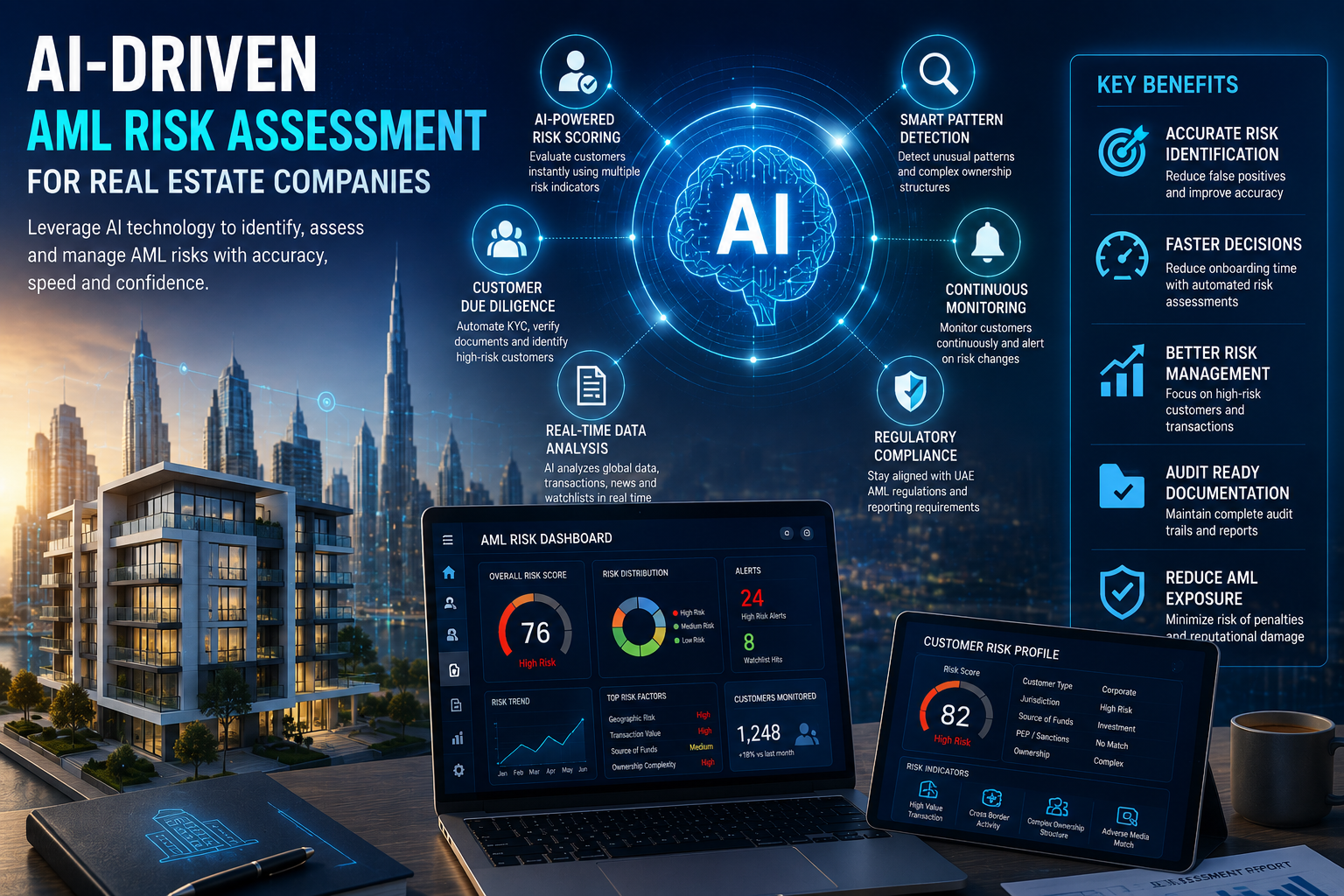
An AI-driven AML risk assessment uses Artificial Intelligence and automation to evaluate customer risk based on multiple data points and predefined compliance rules. Instead of relying solely on manual assessments, AI analyzes customer information, business relationships, and risk indicators to generate consistent and objective risk scores.
When integrated into AML Compliance Software in Dubai, AI helps compliance teams prioritize higher-risk customers while improving efficiency across the onboarding and monitoring process.
Why Risk Assessments Are Critical for Real Estate Companies
Real estate transactions frequently involve:
- High-value property purchases
- International investors
- Corporate ownership structures
- Ultimate Beneficial Owners (UBOs)
- Cross-border fund movements
- Third-party intermediaries
Each of these factors can increase the level of AML risk. Conducting regular AML risk assessments enables businesses to identify high-risk customers and apply appropriate Customer Due Diligence (CDD) and Enhanced Due Diligence (EDD) measures.
How AI Improves AML Risk Assessments
Automated Customer Risk Scoring
AI can analyze multiple customer risk indicators simultaneously, including:
- Nationality and geographic exposure
- Customer type
- Source of funds
- Ownership structure
- Business activity
- Property transaction value
- Previous compliance history
Based on predefined risk parameters, the system automatically assigns a customer risk rating, helping compliance teams focus on higher-risk cases.
Faster Decision-Making
Manual risk assessments often require reviewing multiple documents and customer records individually. AI significantly reduces processing time by evaluating customer information instantly and presenting compliance teams with structured risk insights.
This enables faster onboarding without compromising regulatory compliance.
Consistent Risk Evaluation
Human assessments can vary depending on the experience of the reviewer. AI applies the same predefined risk rules to every customer, ensuring consistency across the organization.
Standardized risk assessments also improve transparency during internal reviews and regulatory inspections.
Ongoing Customer Risk Monitoring
Customer risk does not remain static. AI-powered AML systems continuously monitor registered customers and reassess risk levels whenever relevant information changes.
Examples include:
- Changes in sanctions status
- New adverse media findings
- Changes in ownership structures
- Updated customer information
- Significant changes in business activities
Continuous monitoring enables businesses to respond proactively to emerging risks.
Better Identification of High-Risk Customers
AI helps compliance teams identify customers who may require Enhanced Due Diligence (EDD) by recognizing patterns and combinations of risk indicators that might otherwise be overlooked during manual reviews.
This supports a more effective risk-based approach to AML compliance.
Supporting Regulatory Compliance
UAE regulations require businesses to adopt a risk-based approach to AML compliance. AI-powered AML risk assessment solutions help organizations demonstrate that customer risks are being assessed systematically and consistently.
When combined with AML Compliance Services UAE, AI-driven technology supports:
- Customer Due Diligence (CDD)
- Enhanced Due Diligence (EDD)
- Enterprise-Wide Risk Assessments (EWRA)
- Ongoing customer monitoring
- Internal AML audits
- Regulatory inspections
This strengthens the overall compliance framework and improves regulatory readiness.
Benefits of AI-Driven AML Risk Assessment
Improved Accuracy
AI minimizes manual errors and applies standardized risk assessment methodologies across all customers.
Faster Customer Onboarding
Automated risk assessments reduce processing times while maintaining robust compliance controls.
Better Risk Visibility
Compliance teams gain a clearer understanding of customer risk profiles through centralized dashboards and automated scoring.
Stronger Regulatory Readiness
Consistent documentation and automated audit trails make it easier to demonstrate compliance during regulatory inspections.
Greater Operational Efficiency
Automation allows compliance professionals to focus their efforts on higher-risk customers instead of repetitive administrative tasks.
The Role of AML Compliance Consultants
While AI provides powerful automation capabilities, technology should be supported by professional compliance expertise.
An experienced AML compliance consultant can assist businesses with:
- Developing AML risk assessment methodologies
- Configuring risk scoring models
- Conducting Enterprise-Wide Risk Assessments (EWRA)
- Performing AML audits
- Staff training
- Regulatory advisory services
Combining AI technology with professional compliance services helps businesses establish a comprehensive and sustainable AML framework.
Conclusion
As regulatory expectations continue to evolve, AI-driven AML risk assessment is becoming an essential component of effective compliance management for UAE real estate companies.
By integrating AI-Driven AML Risk Assessment into AML Compliance Software in Dubai, businesses can improve the accuracy of customer risk evaluations, strengthen ongoing monitoring, enhance regulatory readiness, and reduce operational complexity.
For real estate firms operating in today’s high-risk regulatory environment, leveraging AI technology alongside professional AML Compliance Services UAE provides a smarter, faster, and more effective approach to managing AML compliance.