Introduction
The UAE real estate sector has become one of the country’s fastest-growing industries, attracting investors from around the world. While this growth creates significant business opportunities, it also increases exposure to money laundering and financial crime risks. As Designated Non-Financial Businesses and Professions (DNFBPs), real estate companies are required to comply with stringent Anti-Money Laundering (AML) regulations.
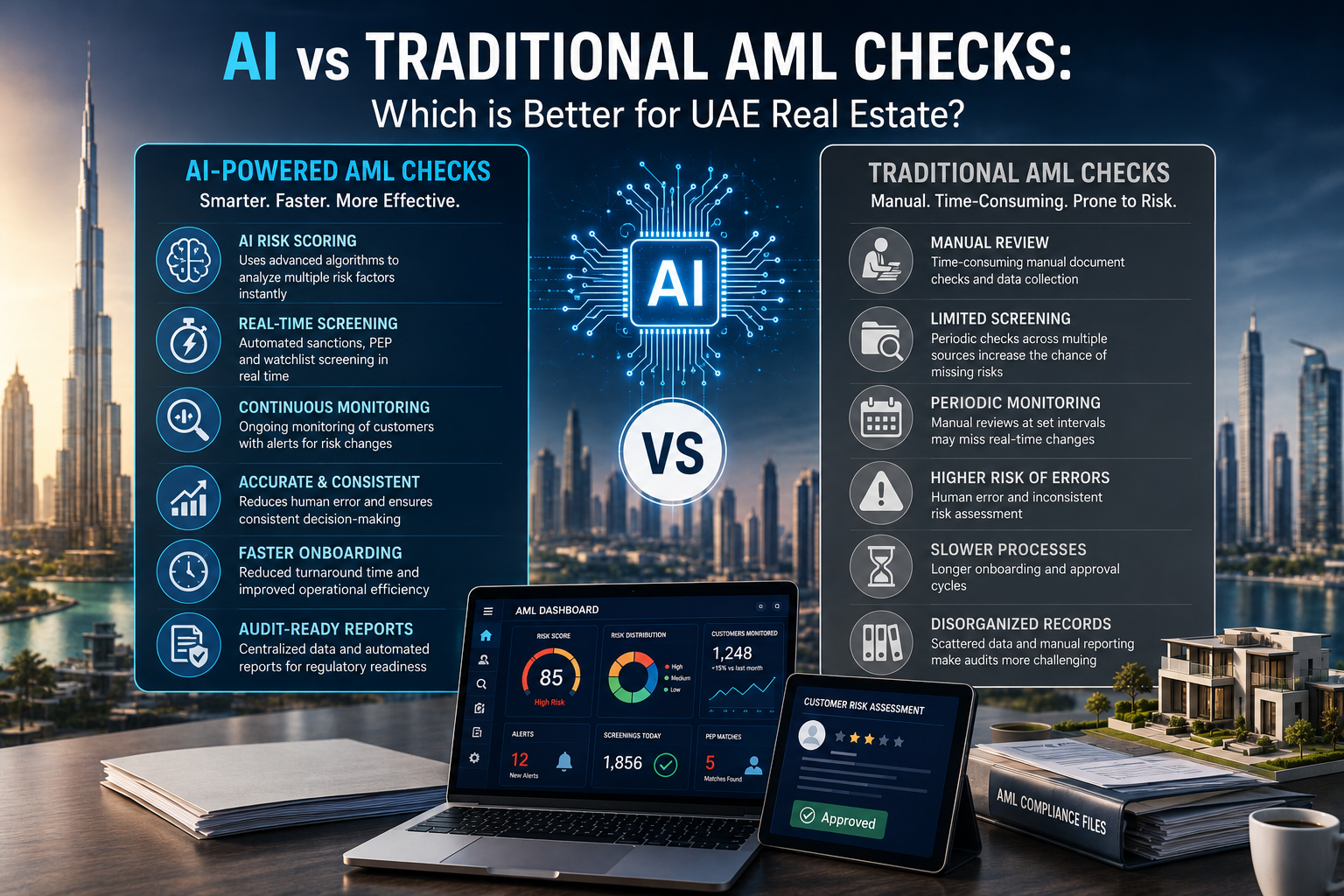
For many years, businesses relied on traditional AML checks performed manually by compliance teams. However, with increasing transaction volumes, evolving regulatory expectations, and more complex customer structures, Artificial Intelligence (AI) is rapidly transforming the way AML compliance is managed.
So, which approach is better for UAE real estate companies—traditional AML checks or AI-powered AML compliance? The answer lies in understanding the strengths of each approach and how technology is reshaping compliance.
What Are Traditional AML Checks?
Traditional AML checks rely primarily on manual processes carried out by compliance professionals. These typically include:
- Reviewing customer identification documents
- Conducting Know Your Customer (KYC) verification
- Performing Customer Due Diligence (CDD)
- Checking sanctions and PEP lists manually
- Assessing customer risk using predefined checklists
- Maintaining compliance records through spreadsheets or document folders
While these methods have served businesses for many years, they often require significant time, effort, and human resources.
What Is AI-Powered AML Compliance?
AI-powered AML compliance uses Artificial Intelligence, automation, and advanced analytics to support compliance teams throughout the customer lifecycle.
Modern AML Software can automate processes such as:
- Customer onboarding
- Identity verification
- Risk scoring
- Sanctions and PEP screening
- Ongoing customer monitoring
- Adverse media monitoring
- Compliance reporting
Rather than replacing compliance professionals, AI enhances decision-making by providing faster insights and identifying potential risks more efficiently.
Comparing AI and Traditional AML Checks
Speed and Efficiency
Traditional AML checks often involve manually reviewing customer documents and searching multiple databases. As customer numbers increase, these processes become slower and more resource-intensive.
AI-powered AML software can complete many of these tasks within seconds, significantly reducing onboarding times while maintaining consistency.
Advantage: AI
Accuracy
Manual reviews are susceptible to human error, particularly when handling large volumes of customer information.
AI applies standardized rules across every customer assessment, helping reduce inconsistencies and improving the accuracy of screening and risk assessments.
Advantage: AI
Ongoing Customer Monitoring
Traditional compliance methods often focus on customer onboarding, with periodic reviews conducted manually.
AI systems continuously monitor registered customers and can automatically identify changes such as:
- New sanctions listings
- Updated PEP status
- Adverse media findings
- Changes in customer risk profiles
This enables businesses to respond more quickly to emerging risks.
Advantage: AI
Risk Assessment
Traditional AML checks generally rely on fixed risk assessment templates completed by compliance officers.
AI can evaluate multiple risk indicators simultaneously, including:
- Geographic exposure
- Customer profile
- Ownership structures
- Transaction values
- Source of funds
- Business activities
This creates a more dynamic and data-driven approach to risk management.
Advantage: AI
Scalability
As real estate firms grow, manually reviewing every customer becomes increasingly difficult.
AI-powered AML platforms can easily support larger customer volumes without requiring proportional increases in compliance resources.
This makes AI particularly valuable for expanding businesses.
Advantage: AI
Human Judgment
Despite advances in technology, compliance professionals continue to play an essential role in AML compliance.
Certain situations require professional judgment, including:
- Complex ownership structures
- High-risk customer relationships
- Unusual transaction patterns
- Regulatory interpretations
- Escalation of suspicious activities
AI provides valuable insights, but experienced compliance professionals remain responsible for making final compliance decisions.
Advantage: Traditional Expertise
Why UAE Real Estate Firms Are Adopting AI
Real estate companies across the UAE are increasingly investing in AI-powered AML solutions because they help businesses:
- Reduce manual compliance workloads
- Improve customer onboarding efficiency
- Strengthen risk assessments
- Enhance ongoing customer monitoring
- Improve audit readiness
- Maintain centralized compliance records
- Respond more quickly to regulatory requirements
These capabilities enable businesses to build stronger and more efficient compliance frameworks.
AI and AML Compliance Services
Technology alone cannot replace a well-designed compliance framework.
Many organizations combine AI AML Compliance in UAE with professional AML Compliance Services Dubai to ensure that technology is supported by sound governance and regulatory expertise.
Compliance consultants can assist with:
- Enterprise-Wide Risk Assessments (EWRA)
- AML policy development
- AML audits
- Staff training
- Compliance reviews
- Regulatory advisory services
This combination of technology and expertise helps businesses maintain sustainable compliance programs.
Which Approach Is Best?
For today’s UAE real estate market, the question is no longer whether businesses should choose AI or traditional AML checks. Instead, the most effective approach combines both.
AI delivers speed, automation, consistency, and continuous monitoring, while experienced compliance professionals provide judgment, regulatory interpretation, and oversight.
Together, they create a stronger, more resilient AML compliance framework.
Conclusion
As financial crime risks become increasingly sophisticated, UAE real estate firms need compliance solutions that are both efficient and effective. Traditional AML checks continue to play an important role, but AI-powered AML Software is transforming how businesses manage compliance by improving speed, accuracy, scalability, and ongoing monitoring.
By combining AI AML Compliance in UAE with experienced AML Compliance Services Dubai, real estate companies can strengthen their compliance programs, reduce regulatory risk, and remain well-prepared for the evolving AML landscape.