Introduction
Anti-Money Laundering (AML) compliance has become an important part of doing business in the UAE, particularly for organizations operating in regulated and higher-risk sectors. As financial crime risks evolve and regulatory expectations become more sophisticated, businesses need effective systems to identify customers, assess risks, maintain records, monitor business relationships, and respond appropriately to suspicious activities.
For regulated businesses, AML compliance should not be viewed simply as a regulatory obligation. A strong compliance framework can protect an organization from financial crime exposure, strengthen its reputation, improve internal processes, and support sustainable business growth.
Professional AML Compliance Services UAE, combined with appropriate AML Compliance Software, can help businesses develop a structured and risk-based approach to managing their AML/CFT responsibilities.
Why AML Compliance Matters for UAE Businesses
The UAE is a major international business and financial centre connecting companies and investors from across the world. This global connectivity brings significant commercial opportunities, but it can also expose businesses to financial crime risks.
Depending on their regulatory classification, businesses may need to address risks associated with:
- Customers from different jurisdictions
- Complex corporate and ownership structures
- High-value transactions
- Politically Exposed Persons (PEPs)
- Sanctioned individuals and entities
- Unusual customer behaviour
- Source of funds and source of wealth
- Cross-border business relationships
An effective AML framework helps businesses identify these risks before they develop into larger compliance or reputational problems.
Building a Risk-Based AML Framework
One of the foundations of effective AML compliance is the risk-based approach.
Rather than treating every customer or business relationship in exactly the same manner, organizations should identify the level of risk involved and apply appropriate controls.
Professional AML Compliance Services can help businesses establish frameworks covering:
- Enterprise-Wide Risk Assessment (EWRA)
- AML policies and procedures
- Customer risk assessment
- Customer Due Diligence (CDD)
- Enhanced Due Diligence (EDD)
- Sanctions and PEP screening
- Ongoing monitoring
- Record retention
- Internal controls
- Staff training and awareness
A structured framework makes AML compliance more consistent and easier to manage across the organization.
Understanding Your Customers
Knowing who you are doing business with is fundamental to managing financial crime risk.
Customer Due Diligence helps organizations understand:
- The identity of the customer
- The nature of the customer’s business
- Ultimate Beneficial Ownership (UBO)
- Purpose of the business relationship
- Geographic exposure
- Source of funds where applicable
- Overall customer risk
Higher-risk customers may require additional information and Enhanced Due Diligence before establishing or continuing the business relationship.
Effective CDD therefore protects the organization while supporting informed business decisions.
Sanctions, PEP and Adverse Media Screening
Customer information can change over time. An individual who presented no significant concerns when initially onboarded could subsequently become subject to sanctions, acquire PEP status, or appear in relevant adverse media.
Screening is therefore an important component of an effective AML compliance framework.
Modern AML Compliance Software can help businesses conduct:
- Sanctions screening
- PEP screening
- Adverse media screening
- Watchlist screening
- Ongoing customer monitoring
Automation makes it easier for compliance teams to identify potential changes in customer risk and investigate relevant alerts.
Improving AML Risk Assessments
Risk assessment should not be treated merely as a compliance document prepared and forgotten.
Businesses need to understand how financial crime risks arise from their customers, geographical exposure, products and services, delivery channels, and business activities.
Professional AML compliance specialists can help organizations conduct an Enterprise-Wide Risk Assessment (EWRA) and develop appropriate controls based on the risks identified.
AML software can further support this process through structured risk scoring, centralized customer information, and consistent assessment methodologies.
Strengthening Regulatory Readiness
Regulatory inspections and independent AML audits can require businesses to demonstrate how their AML controls operate in practice.
It is therefore important to maintain clear records relating to:
- Customer onboarding
- CDD and EDD
- Customer risk assessments
- Screening results
- Compliance decisions
- Internal approvals
- Training
- Policies and procedures
- Ongoing monitoring
A well-organized compliance framework makes it considerably easier to retrieve information and demonstrate the effectiveness of AML controls when required.
The Role of AML Compliance Software
As customer volumes increase, managing AML compliance manually through spreadsheets, emails, and separate documents can become inefficient.
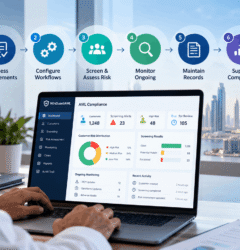
AML Compliance Software can centralize important compliance activities within a single platform.
Depending on the solution, businesses can use technology for:
- Customer onboarding
- Customer risk assessment
- Sanctions and PEP screening
- Adverse media screening
- Ongoing monitoring
- Compliance documentation
- Audit trails
- Compliance dashboards and reports
Automation does not replace the compliance professional. Instead, it provides the tools needed to manage information more efficiently and make better-informed compliance decisions.
Reducing Operational Burden
AML compliance can involve substantial administrative work, particularly when processes are managed manually.
Professional AML Compliance Services Dubai combined with technology can help reduce repetitive compliance tasks and enable internal teams to concentrate on higher-risk matters.
This can improve:
- Compliance efficiency
- Consistency of customer assessments
- Record management
- Response times
- Internal oversight
- Audit readiness
For growing businesses, this becomes particularly important as the number of customers and business relationships increases.
Protecting Business Reputation
AML failures can create consequences beyond regulatory action.
Association with suspicious customers or financial crime can affect relationships with:
- Banks
- Customers
- Investors
- Business partners
- Regulators
- International counterparties
A strong AML framework demonstrates that the organization takes financial crime prevention, transparency, and corporate governance seriously.
This can help strengthen confidence among stakeholders and support the company’s long-term reputation.
Supporting Sustainable Business Growth
Compliance and business growth should not be viewed as competing objectives.
An effective AML framework can actually support expansion by creating standardized processes that allow businesses to onboard and manage customers more efficiently.
As an organization expands into new markets, introduces new services, or increases its customer base, scalable AML Compliance Software and professional compliance support can help ensure that the AML framework develops alongside the business.
Why Professional AML Compliance Services Matter
AML regulations and financial crime risks continue to evolve. Businesses therefore need more than a one-time AML policy or occasional customer screening.
Experienced AML professionals can support organizations through:
- AML/CFT framework development
- Enterprise-Wide Risk Assessments
- AML audits and compliance reviews
- Customer risk assessment methodologies
- AML training
- Policy and procedure updates
- Compliance advisory
- Ongoing regulatory support
Combining professional expertise with technology creates a more comprehensive approach to AML compliance.
Technology and Human Expertise: The Right Combination
AML technology is increasingly sophisticated, but professional judgment remains essential.
Software can identify potential matches, calculate risk scores, organize records, and generate alerts. Compliance professionals must evaluate those results, understand the circumstances surrounding the customer or business relationship, and determine the appropriate action.
The strongest compliance programs therefore combine AML Compliance Software with experienced compliance professionals rather than relying exclusively on either manual processes or technology.
Conclusion
AML compliance is more than a regulatory requirement—it is an important component of responsible and sustainable business management.
A strong AML framework helps businesses understand their customers, identify financial crime risks, improve internal controls, protect their reputation, and remain prepared for regulatory scrutiny.
By combining professional AML Compliance Services UAE with modern AML Compliance Software, businesses can create a more efficient, structured, and risk-based approach to compliance.
For organizations operating in today’s increasingly transparent and regulated business environment, investing in effective AML compliance is not simply about meeting regulatory expectations. It is about protecting the business, strengthening stakeholder confidence, and creating a stronger foundation for long-term success.