Introduction
The UAE has established one of the region’s most comprehensive Anti-Money Laundering (AML) and Counter-Terrorism Financing (CTF) frameworks. Businesses operating in regulated sectors are required to implement robust compliance measures to identify, assess, and mitigate money laundering and terrorist financing risks.
As regulatory expectations continue to evolve, organizations are increasingly adopting AML Software to streamline compliance processes and strengthen risk management practices. Modern AML Compliance Software in Dubai enables businesses to automate key compliance activities while maintaining alignment with UAE regulatory requirements.
Understanding how AML compliance software works within the UAE’s regulatory landscape can help businesses make informed decisions about their compliance strategy.
Understanding the UAE AML Regulatory Framework
The UAE’s AML framework requires businesses to adopt a risk-based approach to compliance. Regulated entities are expected to establish internal controls that support the identification, assessment, monitoring, and reporting of financial crime risks.
Businesses must typically implement measures relating to:
- Customer identification and verification
- Customer Due Diligence (CDD)
- Enhanced Due Diligence (EDD)
- Risk assessments
- Sanctions screening
- Ongoing monitoring
- Record retention
- Suspicious transaction reporting
- Staff training and awareness
AML software helps organizations manage many of these obligations through automation and centralized compliance management.
How AML Compliance Software Supports Regulatory Compliance
Customer Onboarding and KYC Verification
The compliance process begins when a new customer is onboarded.
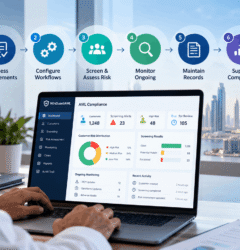
AML software assists organizations by collecting customer information and supporting Know Your Customer (KYC) procedures. Businesses can verify customer identities, gather supporting documentation, and maintain centralized records for future reference.
This helps create a structured and auditable onboarding process.
Customer Due Diligence and Risk Assessment
UAE regulations require businesses to assess customer risk levels and apply appropriate due diligence measures.
AML software facilitates this process by evaluating various risk factors, including:
- Customer profile
- Geographic exposure
- Nature of business activities
- Ownership structures
- Source of funds information
Based on predefined criteria, the system can assign risk ratings and support risk-based compliance decision-making.
Sanctions and PEP Screening
One of the core functions of AML software is screening customers against:
- International sanctions lists
- Politically Exposed Persons (PEP) databases
- Adverse media sources
- Other relevant watchlists
Automated screening allows businesses to identify potentially high-risk customers quickly and efficiently while maintaining proper documentation of screening results.
Ongoing Customer Monitoring
AML compliance does not end after onboarding. Businesses are expected to continuously monitor customer relationships and reassess risks when necessary.
AML software helps organizations maintain ongoing monitoring by:
- Reviewing customer profiles periodically
- Generating alerts for risk profile changes
- Monitoring sanctions and PEP status updates
- Supporting periodic customer reviews
This enables businesses to maintain stronger compliance oversight throughout the customer lifecycle.
Document Management and Record Retention
Regulated entities are required to maintain customer records and compliance documentation for prescribed retention periods.
AML software centralizes:
- Customer identification documents
- Risk assessments
- Screening results
- Compliance reviews
- Audit logs
This makes it easier to retrieve information during regulatory inspections or compliance reviews.
Supporting Internal AML Audits and Risk Assessments
AML software plays an important role in helping businesses prepare for AML audits and periodic risk assessments.
The system provides:
- Historical compliance records
- Audit trails
- Customer risk profiles
- Monitoring logs
- Compliance activity reports
These records help demonstrate the effectiveness of an organization’s compliance framework.
Benefits of AML Software in the UAE
Improved Compliance Efficiency
Automation reduces manual workloads and enables compliance teams to focus on higher-risk activities.
Greater Accuracy
Automated screening and risk assessment processes help reduce human errors and inconsistencies.
Better Regulatory Readiness
Businesses can maintain organized records and demonstrate compliance during inspections or audits.
Enhanced Risk Management
Continuous monitoring and risk scoring help organizations identify emerging risks more effectively.
Scalability
AML software can support growing customer volumes and increasing compliance obligations without significantly increasing operational complexity.
The Role of AML Compliance Services
While technology provides the operational framework, many organizations also engage professional AML Compliance Services UAE to strengthen their compliance programs.
AML consultants can assist with:
- Enterprise-wide risk assessments
- AML policy and procedure development
- AML audits
- Compliance reviews
- Staff training
- Regulatory advisory services
Combining AML technology with professional compliance expertise helps organizations build a more comprehensive compliance framework.
Why Technology Is Becoming Essential
As regulatory expectations increase, businesses are finding it increasingly difficult to manage compliance using manual processes alone.
Modern AML Software helps organizations:
- Improve compliance consistency
- Maintain stronger internal controls
- Reduce operational risks
- Enhance regulatory readiness
- Improve documentation and reporting
Technology is becoming a critical component of effective AML compliance management across the UAE.
Conclusion
AML Compliance Software in Dubai plays a vital role in helping businesses navigate the UAE’s evolving regulatory environment. From customer onboarding and risk assessment to sanctions screening, ongoing monitoring, and audit readiness, AML software supports organizations throughout the entire compliance lifecycle.
By combining advanced AML Software with professional AML Compliance Services UAE, businesses can strengthen compliance controls, improve operational efficiency, and remain aligned with regulatory expectations in an increasingly complex financial crime landscape.