Introduction
The UAE real estate sector involves high-value transactions, international investors, corporate buyers, and customers from a wide range of jurisdictions. These characteristics can create exposure to money laundering and other financial crime risks, making effective Anti-Money Laundering (AML) controls particularly important for regulated real estate businesses.
Traditionally, many real estate companies have managed AML compliance manually using spreadsheets, documents, emails, and individual screening checks. While manual processes can work for businesses with a relatively small customer base, they can become increasingly difficult to manage as transaction volumes and compliance requirements grow.
This has led to greater adoption of UAE AML Compliance Software and automated compliance solutions. But does automation completely replace manual compliance? Or is a combination of technology and professional judgment the better approach?
Understanding the differences between Manual AML Compliance in UAE Real Estate and automated AML compliance can help businesses determine the most effective approach.
What Is Manual AML Compliance?
Manual AML compliance refers to processes performed primarily by employees or compliance professionals without a centralized automated AML platform.
These activities may include:
- Collecting customer identification documents
- Maintaining KYC files manually
- Screening customer names individually
- Completing customer risk assessment forms
- Maintaining spreadsheets of customer information
- Tracking document expiry dates manually
- Conducting periodic customer reviews
- Maintaining separate compliance records and reports
Manual compliance does not necessarily mean ineffective compliance. Experienced compliance professionals can perform detailed reviews and exercise judgment that technology alone cannot provide.
However, the challenge arises when the volume of customers and compliance activities increases.
Challenges of Manual AML Compliance in UAE Real Estate
Time-Consuming Customer Onboarding
Real estate transactions can involve individual purchasers, corporate entities, investors, representatives, and Ultimate Beneficial Owners (UBOs).
Collecting, reviewing, screening, and recording information for each party manually can require significant time.
This can slow customer onboarding and place additional pressure on compliance and sales teams.
Greater Possibility of Human Error
Manual data entry and record management can create inconsistencies.
For example, employees may:
- Miss required information
- Enter incorrect customer details
- Forget to update risk assessments
- Miss scheduled customer reviews
- Maintain incomplete screening records
Automation can help standardize many of these repetitive compliance processes.
Difficulty with Ongoing Monitoring
Customer risk does not remain static after onboarding.
A customer may subsequently:
- Become subject to sanctions
- Acquire PEP status
- Appear in adverse media
- Experience a change in ownership
- Present new risk factors
Manually re-screening every customer regularly can become difficult as the customer database grows.
Fragmented Compliance Records
When information is maintained across spreadsheets, emails, shared folders, and physical documents, retrieving a complete customer compliance history can become challenging.
This is particularly important when preparing for an AML audit, internal review, or regulatory inspection.
What Is Automated AML Compliance?
Automated AML compliance uses specialized technology to manage and streamline key compliance processes.
Modern UAE AML Compliance Software can bring customer information, screening, risk assessment, monitoring, and compliance records into a centralized system.
Depending on the platform, automation can support:
- Customer onboarding
- KYC information management
- Sanctions screening
- PEP screening
- Adverse media screening
- Customer risk scoring
- Ongoing monitoring
- Compliance alerts
- Document management
- Audit trails and reporting
The objective is not to remove the compliance professional but to reduce repetitive manual work and provide better information for decision-making.
How AI Is Changing AML Compliance in Real Estate
Artificial Intelligence is adding another layer of capability to AML technology.
AI AML Compliance in UAE Real Estate can assist businesses in evaluating multiple risk indicators and identifying information that may require closer examination.
AI-supported systems can help with:
- Customer risk classification
- Identifying potential screening matches
- Analysing multiple risk factors
- Prioritising compliance alerts
- Identifying changes in customer risk
- Supporting more efficient compliance reviews
As AI capabilities develop, compliance teams can spend less time on repetitive administrative work and more time evaluating higher-risk customers and complex cases.
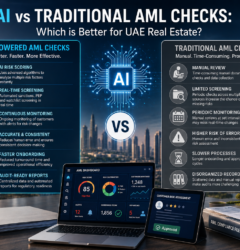
Manual vs Automated AML Compliance: Key Differences
Customer Screening
Manual approach:
Compliance staff search customer names and review results individually.
Automated approach:
AML software screens customers against relevant sanctions, PEP, watchlist, and adverse media data and presents potential matches for review.
Better approach: Automated screening supported by human review.
Customer Risk Assessment
Manual approach:
Risk assessments are completed using spreadsheets, forms, or checklists.
Automated approach:
Software can apply predefined risk factors and scoring methodologies consistently across customers.
Better approach: Automation for consistency combined with professional judgment for complex or higher-risk cases.
Ongoing Monitoring
Manual approach:
Customers need to be periodically re-screened or reviewed by employees.
Automated approach:
The system can support ongoing monitoring and alert compliance teams when relevant customer information changes.
Better approach: Automation, particularly for businesses managing larger customer databases.
Record Management
Manual approach:
Documents may be stored across folders, spreadsheets, emails, and other locations.
Automated approach:
Customer compliance information can be maintained centrally with an accessible history of compliance activities.
Better approach: Automated centralized record management.
Compliance Decision-Making
Manual approach:
Experienced compliance professionals assess the circumstances and make decisions.
Automated approach:
Software provides risk scores, screening results, alerts, and supporting information.
Better approach: Human expertise. Technology should support compliance decisions rather than make every decision independently.
The Importance of Human Judgment
Even sophisticated AI AML Software Dubai cannot completely replace experienced compliance professionals.
AML compliance frequently requires contextual judgment.
For example, a potential sanctions or PEP match identified by software needs to be reviewed to determine whether it relates to the actual customer.
Similarly, a high customer risk score does not automatically mean that a business relationship should be rejected. Compliance professionals need to understand why the customer was classified as higher risk and determine what additional due diligence may be appropriate.
Human judgment is particularly important when dealing with:
- Complex corporate structures
- High-risk jurisdictions
- Politically Exposed Persons
- Source of funds and source of wealth
- Higher-risk customers
- Unusual customer circumstances
- Potential suspicious activity
Technology provides information. Compliance professionals determine how that information should be interpreted and acted upon.
Why a Hybrid Approach Works Best
The most effective solution for many UAE real estate businesses is therefore not choosing between manual and automated compliance.
It is combining the strengths of both.
Automation can manage repetitive, high-volume processes such as:
- Screening
- Risk scoring
- Customer record management
- Ongoing monitoring
- Alerts
- Compliance documentation
Compliance professionals can then focus on:
- Reviewing potential matches
- Enhanced Due Diligence
- Higher-risk customers
- Complex ownership structures
- Compliance decisions
- Internal escalation
- Regulatory obligations
This creates a more efficient risk-based compliance model.
Role of AML Compliance Services
Software alone does not constitute a complete AML compliance framework.
Professional AML Compliance Services Dubai can support real estate businesses with areas such as:
- AML/CFT policy and procedure development
- Enterprise-Wide Risk Assessment (EWRA)
- Customer risk assessment methodologies
- AML audits and independent reviews
- Staff training
- Compliance advisory
- Regulatory updates
Combining professional compliance expertise with AML technology helps ensure that automation operates within a properly designed AML framework.
Benefits of Automated AML Compliance for Real Estate Businesses
Moving from predominantly manual processes to a technology-supported compliance framework can provide several benefits:
- Faster customer onboarding
- More consistent customer screening
- Structured customer risk assessments
- Improved ongoing monitoring
- Centralized compliance records
- Better audit trails
- Reduced repetitive administrative work
- Improved regulatory readiness
- Greater scalability as the business grows
These benefits become increasingly important as a real estate company’s customer base and transaction activity expand.
Does Every Process Need to Be Automated?
No.
Automation should be introduced where it improves efficiency, consistency, record keeping, and risk management.
Certain compliance activities still require professional involvement, particularly where the business needs to interpret information, investigate unusual circumstances, or determine an appropriate compliance response.
The objective should therefore be effective AML compliance, rather than automation for its own sake.
Choosing the Right AML Compliance Approach
Real estate businesses considering a move from manual compliance to UAE AML Compliance Software should assess:
- Number of customers
- Volume of screening activity
- Complexity of customer profiles
- Current AML processes
- Compliance resources
- Ongoing monitoring requirements
- Reporting and record-keeping needs
- Expected business growth
A smaller business may initially manage certain processes manually, while a growing real estate company may quickly benefit from greater automation.
The compliance framework should ultimately be proportionate to the nature, size, complexity, and risk exposure of the business.
Conclusion
Both manual and automated approaches have a role in AML Compliance in UAE real estate businesses.
Manual compliance provides the human judgment, experience, and contextual understanding required for complex AML decisions. Automated AML software provides speed, consistency, scalability, centralized records, and more efficient ongoing monitoring.
For most regulated UAE real estate businesses, the strongest approach is therefore a combination of the two.
By integrating AI AML Compliance in UAE Real Estate with experienced compliance professionals and appropriate AML Compliance Services Dubai, businesses can reduce manual workloads while maintaining the human oversight necessary for effective risk-based compliance.
The future of AML compliance in the UAE real estate sector is not simply replacing people with technology. It is using technology to enable compliance professionals to work more efficiently, consistently, and effectively.